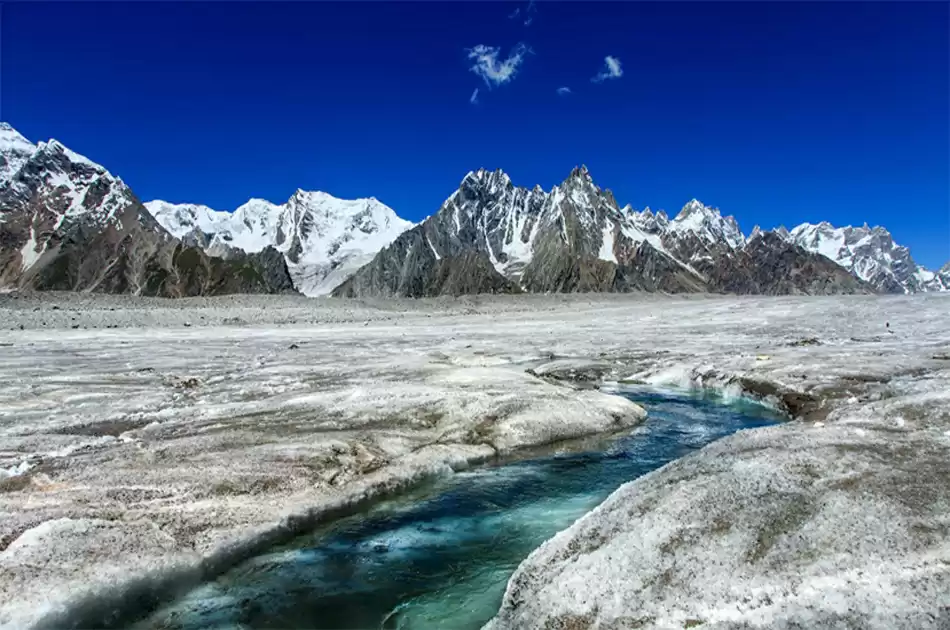
15 Days Trek Chilinji Pass Chapursan Valley Pakistan
About this tour
15-day trip, 7 nights camping & 6 nights in hotels. Descending down from The Chilinji Pass (5247 meters in Chapursan Valley
The Chilinji Pass route has only recently been opened for tourists and is one of Pakistan’s most remote treks. It takes trekkers from the Ishkoman Valley (near Gilgit) to the Chapursan Valley in the upper Hunza, a journey through richly contrasting landscapes. The route runs parallel to the Wakhan corridor near the Afghanistan and Tajikistan borders. Nomads from both these countries still make the journey to the Chapurson Valley bringing their yaks, sheep and goats to trade for sugar, tea, cigarettes and other goods from Sost.
Day-by-day itinerary
Day 1: Islamabad, Pakistan
Arrive in Islamabad Day in Islamabad to finalise trekking permits with the Ministry of Tourism. Evening free.
Day 2: Islamabad, Pakistan to Naran, Pakistan
Islamabad - Chilas /Narran After breakfast, drive to Chilas / Narran along the Karakoram Highway (KKH), the 500-kilometre legendary route that winds its way through the Himalayan, Hindu Kush and Karakoram mountains. Construction of the highway, known as the eighth wonder of the world, was a joint venture between Pakistan and China, took 20 years to complete and cost the lives of about 850 workers. Meals and overnight at hotel. (500 km, 12-hour drive in air-conditioned bus)
Day 3: Naran, Pakistan to Yasin Valley
Narran - Chatorkhan Continue along the KKH to Gilgit, through the precipitous gorge of the Indus River. As we near Gilgit we will get our first spectactular view of Nanga Parbat (8125m). After lunch in Gilgit we transfer to 4x4 soft-top jeeps and continue the drive towards the Ghizar Valley and the village of Chatorkhan, our first overnight camping site. Overnight at hotel. (230 km, 8/9 hours)
Day 4: Yasin Valley to Sost
Chatorkhan - Bilhinz If road conditions permit we will drive as far as Bilhinz, otherwise we will take the easy trek from Chatorkhan into the Ishkoman Valley. We camp overnight at the small village of Bilhinz. ( 2-hour drive, 5-6 hour walk)
Day 5: Yasin Valley to Passu Cones Viewpoint, Hunza Nagar
Bilhinz - Matramdas Today, if road conditions permit we will make half the journey by jeep, otherwise it will be an easy day’s walk to our overnight camping site at Matramdas, a friendly village of about 10 houses beside the Chilinji River, the last permanent settlement before the Chilinji Pass. (6-7 hour walk)
Day 6: Yasin Valley to Sost Bazar, Sost
- Matramdas - Yasin An early start today, because after a 15-minute walk, we must cross a water channel before the water level gets too high. After an easy day’s trekking we arrive at Yasin, the most beautiful camping site on our trek with its green meadows and trees. ( 5-6 hour walk)
Day 7: Yasin Valley to Sost Bazar, Sost
Yasin - Chilinji A steep climb of about 200 metres to begin the day as we make our way to a point to cross the Yasin Glacier. It is easy walking after this to the Chilinji River which we will cross on a swinging pulley, one by one. We camp overnight at the Chilinji summer settlement. ( 5-6 hour walk)
Day 8: Yasin Valley to Sost Bazar, Sost
Chilinji - High camp Today, as the whole trek is uphill, we will make an early start. From Chilinji we will turn toward east for Chilinji Pass (to the west lies the Broghil Valley and the route towards Chitral). After resting at the Chilinji Pass base camp we will make the steep climb to the high camp just below the pass. (7-8 hour uphill walk)
Day 9: Yasin Valley to Sost Bazar, Sost
Across Chilinji Pass - Baultar From the high camp it will take us about three hours to climb the 250 metres to the top of the pass. From the summit it is all downhill to Baultar via a series of snowfields along the Chilinji Glacier. Our day’s walk ends at Baultar, an oasis of green that lies parallel to the Wakhan corridor and the Chilinji River, where shepherds live in stone cottages. Overnight camping at Baultar. (7-8 hour walk)
Day 10: Sost Bazar, Sost to Passu Cones Viewpoint, Hunza Nagar
Baultar - Ziarat BabaGhudi - Passu We walk along the Chapurson Valley which will provide a gentle contrast to the Ishkoman Valley which we trekked through earlier. We cross the red mountains that form the boundary between the Hindukush and Karakoram ranges and arrive at the holy place of Ziarat Baba Ghundi, where there is a shrine to the famous Muslim saint Baba Ghundi Shah. After lunch here we join our jeeps again and drive towards Sost, the last Pakistani town before the Chinese border and then down the Karakoram Highway towards Passu in the upper Hunza Valley. The small, picturesque village of Passu is set against a backdrop of the soaring Passu Cones, and is a short walking distance from the Passu and Batura glaciers. There will be an opportunity to walk through the village and experience local life. About 70 years ago Passu was the second largest settlement in Hunza (after Karimabad). However, the glacier upstream of the Hunza River created a huge dam which later broke, washing away the houses and fertile fields. Now the river has claimed the major share of the valley, confining Passu village to its right bank. Overnight at lodge. (5-6 hour walk, 4-5 hour drive)
Day 11: Hunza, Hunza Nagar to Naran, Pakistan
Passu - Karimabad A morning walk to the Passu Glacier and Passu Lake (45 minutes one-way). From the snout of the glacier there are spectactular views of Shispar ( 7611m) and Passu (7478m) peaks. We will also visit the famous suspension bridges of Passu. These 250m-long bridges over the Hunza River are still used by the local people, who are known for their friendliness towards visitors. Then we drive to Karimabad, capital of upper Hunza and its panoramic views of some of the most beautiful peaks of the Karakoram -Rakaposhi, Diran, Ultar, Golden Peak. In Hunza each family is self sufficient in wheat, maize, apricots and walnuts and they also make their own clothes, shoes, wooden and stone bowls. In the afternoon there is time to walk to Ultar Glacier by following an irrigation channel through the village, or to stroll through the single-lane bazaar for more views of the peaks that soar overhead and to visit the 800-year-old Altit and Baltit forts. Overnight in hotel.
Day 12: Naran, Pakistan to Islamabad, Pakistan
Karimabad - Chilas En route for Chilas we make a short stop at the Rakaposhi (7788m) viewpoint and later have lunch at Gilgit and stroll through the colourful bazaar. At Kargah there is an ancient reminder of the area’s history as a route used by silk traders, and by Buddhist monks on their journeys to Taxila – a 7th century AD Buddha carved into the rock. Overnight at Chilas hotel, beside the Indus River. (260km, 6-7 hour drive.)
Day 13: Naran, Pakistan to Islamabad, Pakistan
Narran Chilas - Islamabad An early start for the 12-hour drive along the Karakoram Highway to Islamabad with a short stop at Besham for lunch. Overnight in Islamabad hotel. (500km, 11-12 hour drive)
Day 14: Naran, Pakistan to Islamabad Motorways Toll Plaza, Islamabad, Pakistan
An early start for the 12-hour drive along the Karakoram Highway to Islamabad with a short stop at Besham for lunch. Overnight in Islamabad hotel. (500km, 11-12 hour drive)
Day 15: Islamabad Airport Road, Islamabad, Pakistan to Aabpara, Islamabad, Pakistan
Departure Transfer to airport for flight home.
What's included
Cost Includes: Accommodation on twin-share basis at standard category hotels in towns, 2-person dome tent during trek. Meals: half board at hotels, full board during trek; Transport: Air conditioned transport and soft-top 4x4 jeeps to trek head & trek end; Camping facilities: 2-person dome tents with mattresses, dining tent with folding table & chairs, kitchen tent and staff, toilet tent; Portage of 15kg during trek; Tips & Portage at airport & hotels, entrance fee at sites & museums. English speaking mountain guide.
Cost Does Not Include: Domestic/International airfares and airport taxes; any expenses due to cancellation of flights, landslide or other natural calamities or acts of God beyond the control of Logistic Services Provider , their staff and suppliers; any expenses of a personal nature not mentioned above.
What to know
GEAR AND CLOTHING LIST For Trekking GEAR & Clothing While on an organised trek, it is best to pack all items for your trip in one large piece and one carry on. The large piece must be a duffel bag (weighing not more than 12.5 Kg.) because duffels are easier for porters to carry. A small day pack is suggested as carry-on to keep items that you will use during while on the trek, bus or jeep. Luggage Large duffel bag with lock. It is not recommended to put your stuff in backpack as the straps might get damaged while being transferred from bus to jeeps, jeeps to campsites and during loading and unloading by porters each day. A small padlock that fits through the zipper of your duffel bag is recommended. Day Pack. Large enough for camera gear, cap, sun glasses, water bottle, jacket and other items you may like to use while on the trek. Extra carry-on. For storing city clothes in Skardu. Money Belt. A small fanny pack, money belt or around the neck passport bag is suggested for keeping safe your passport, travel documents and money. Packing list for your Duffel. Sleeping Bag. As we shall be sleeping for four nights at Concordia at 4,700meters or at Snow Lake and Hispar Pass at 5151meters above sea level, so the bag should be rated for 0 degree F or -18 degree C. Ratings are all relative since the amount of insulation needed for a particular person to stay comfortable depends on their rate metabolism. A down bag will be warmer for its weight and pack smaller but does not retain its insulative properties when wet. A water proof breathable shell or a bivy-bag will keep the bag dry. A synthetic bag keeps you warm even when wet and is a less expensive alternative, but will weigh more for a given amount of warmth. Trekking Boots. The single most important item on this list. Never take brand new boots on a trek, make sure they are well broken-in before departure. Good trekking boots are hard to get in Pakistan. If you are buying a new pair from abroad, look for medium-weight boots of fabric or a fabric/leather combination. They should provide adequate ankle support . A vibrum or other deep-lug will protect you from rocks and add support. Always use thick socks when trying shoes so that you get the correct size. Short shoes can jam your toes painfully during steep descents. You could also try to get new “Grouted” shoes that provide protection against water and are good while walking in rain or through snow. Make sure you can fit crampons on your shoes, as it is vital for crossing different passes. Camp Shoes. Jogging shoes or sneakers to slip in at the end of the day. Tiva sandals are ideal for this trek, as you can use them while crossing streams and also at the campsite for strolls. Crampons You may need crampons on certain treks, sometimes only for one day. It helps in having better grip on hard snow to have crampons fitted to your boots. Look for easy to fix ones. ( Check with us for your specific trek if you need the crampons or not). From our regular trek list, you would need to bring crampons for : Gondogoro La, Biafo Hispar and Wartum Peak Thermal socks. The socks you wear are a critical element. A cotton/wool combination is useful while on the glacier, and for warmer conditions cotton socks are best. For hose who are sensitive to wool synthetic/cotton socks are recommended. Liner Socks. A thin, wickable material. Polypropylene, Capilene, Thermax and Drylete all work very well. Silk does not work nearly as effectively as any one of the above. Polyester Fleece/Pile Jacket or Pullover. Stays warm even when wet. Polyester Fleece Pants. Good for afternoon strolls, same as above. Rain gear. A rain suit available from the local market is best for rain, doubles as windbreaker, and fits over pile jacket and pants. Wicking Long Underwear (tops & bottoms). Wick moisture to keep you warm and comfortable and dry quickly. Two suits are a good idea. Ski Hat. Covers your ears properly, use one with cotton liner. Woolen cap is also good. Mittens or Gloves. Woolen gloves are useful when at higher elevations and during windy conditions, when temperature drops quickly. Brimmed Sun Hat. Very important for this trek, as when we start the trek and till we arrive at Concordia, we are generally walking towards east. This can be annoying in the morning as sun is low and hits your eyes. Bathing Suit. Men can take bath by the rivers or occasional lakes in ablation valleys. Toiletries. Keep everything you normally use. Just remember to bring effective sunscreen, chap stick /lip balm, skin lotion and laundry soap. CLOTHING With your knowledge of Pakistani culture you are well aware of precautions to be taken while traveling through remote areas. Cloths for the trek should be durable, comfortable and easy to wash and dry. In good weather you will spend much of your time in a T-shirt or medium shirt and outdoor trousers. You will need warmer clothes for evening in the camps. Temperature falls rapidly as soon the sun goes down. Men could wear shorts once we are through the populated areas, that means from the third day of trek. Women are advise to use cotton shalwar kameez (loose long shirts and baggy trousers) the traditional Pakistani dress, as these are comfortable during warm conditions, and also appreciated & respected by the locals. Check List Head gear Parka Wool shirt & trousers Sweater Cotton shirt & pants Gloves & Mittens Rain/wind suit Cotton & Wool undergarments Socks (Cotton & Wool/synthetic) Boots (Trek & Camp) Belt ! Down Jacket Shalwar Kameez (Cotton) Spare laces for boots Miscellaneous Items Sunglasses Towel Washcloth Bandanna/Scarf, for covering your mouth while riding in a jeep. Water bottle, with durable screw top. Sunscreen Headlamp with flash light + extra batteries and bulb Insect repellent Swiss Army knife, or a similar one Nylon cord for a clothes line Personal Medical kit Pocket size sewing kit Lighter or matches for general use Wrist Watch Optional Items Thermarest. We provide close-cell matrices but you may want to supplement for additional comfort. Stuff sacks of various sizes for storing of your used clothes. Toilet paper or travel pack of tissues. An interesting book. Note book and pen for journal. Snacks: personal choice of dried fruit, candy, energy bars. Binoculars. Camera, film, extra batteries, cleaning supplies and extra lenses. Sports gear (playing cards/Frisbee) Water purification tablets
Route & locations
Islamabad, Pakistan