18 Days Round Trek Shimshal Chafchingol Pass Pakistan
About this tour
18 Days Adventure, 12 days strenuous trek, 12 nights camping and 6 nights in hotels. Maximum Elevation 5,151 meters
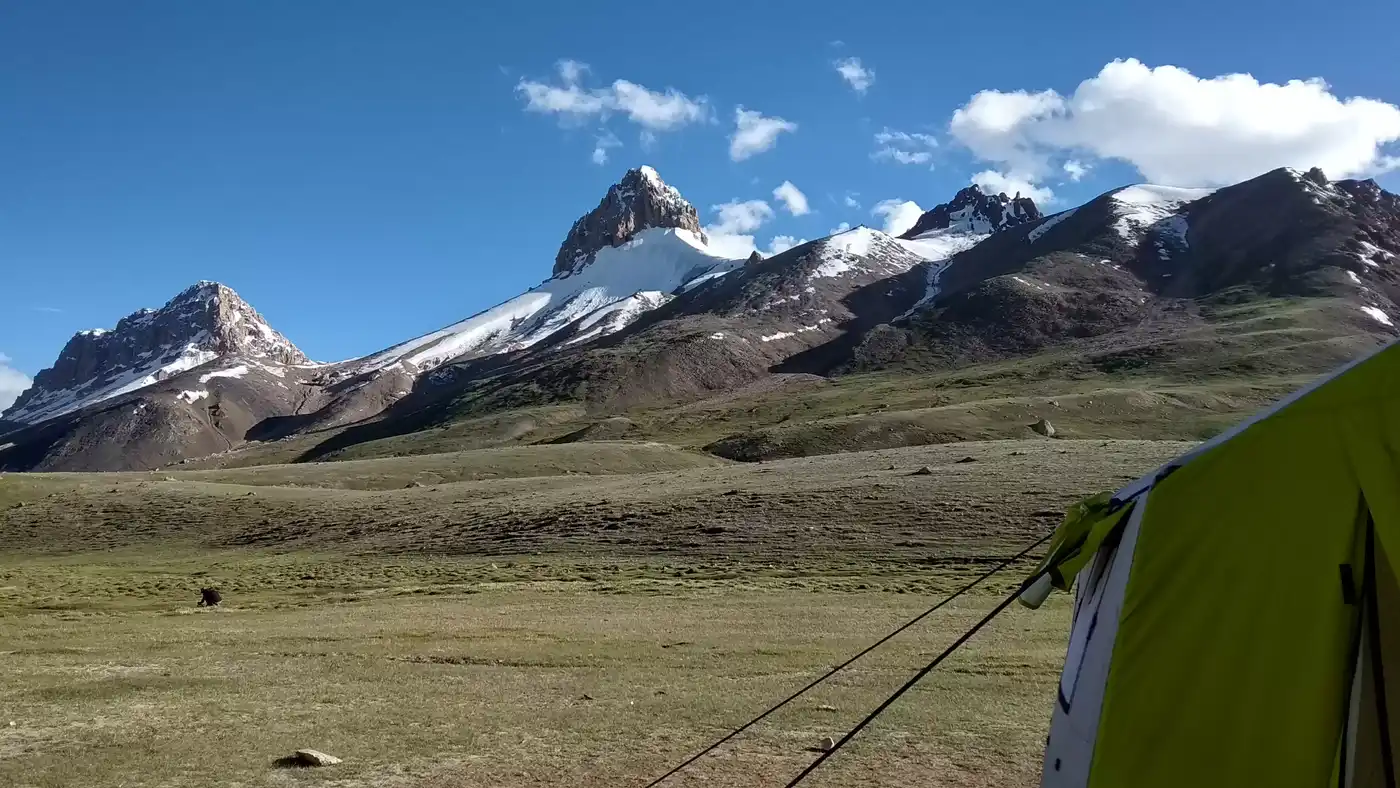
Situated in the heart of Karakoram range is Shimshal, the remotest valley in the whole range. The mountains are some of the toughest, with some of the high virgin peaks lying here. You start the trip in Islamabad and drive on legendary Karakorum Highway to Passu in upper Hunza, from where we take soft top 4x4 jeeps to enter the valley. It takes two days walk to reach the main village - Shimshal in the valley. From the village it is 4 days trek to the summer settlement, towering above two lakes and flower filled meadows roamed by Yaks. After rest at meadows, we take a six days trek over three passes to arrive at Karakorum Highway, just south of Khunjerab Pass at Pak China border
Day-by-day itinerary
Day 1: Islamabad Airport Road, Islamabad, Pakistan to Naran, Pakistan
Islamabad – Chilas/Narran Arrive Islamabad, after short stay for fresh up and breakfast drive on the Karakoram Highway to Besham in air conditioned transport. Overnight stay in hotel. (260 km, 6/7 hours)
Day 2: Naran, Pakistan to Hunza, Hunza Nagar
Narran/Chilas to Hunza Exciting drive through the gorge of Indus & Hunza rivers. En route visit the meeting point of the worlds three highest mountain ranges; Himalayas, Hindukush and Karakoram. Enjoy views of Nanga Parbat (8,125 m) & Rakaposhi (7,788 m). Overnight in hotel. ( 515 km, 8/9 hours)
Day 3: Hunza, Hunza Nagar to Shimshal Valley Road, Hunza Nagar
Hunza - Shimshal: After two hours Jeep drive we will be in Shimshal, opposite to Mulungudi glacier, with hot springs. We have beautiful view of Dastagil Sar (7885m). As we walk from Kuk,. From here it is easy descend to the main valley and an hour & half to main village. Shimshal is one of the remotest areas of Karakoram. 900 years ago Shimshal Valley was discovered by a Sufi Saint he settled here and all Shimshali people are from his family. Camp overnight. (7/8 hours, 3300m)
Day 4: Shimshal Valley Road, Hunza Nagar to Shimshal
Shimshal – Pasth Furzin: For the next two days, our walk would mostly be traverse through the really narrow gorge of Shimshal River. But our walk from the village for the first two hours today is in the open valley along the river. Soon we leave the main valley and turn to left to enter the gorge. Mostly the trek is safe, although at few places you would need good balance on the narrow foot track. Enroute enjoy views of Kunianchish and Yazgildoom. Furzin, a narrow camp along the side stream is known for its Birch trees. Overnight in Furzin. (5/6 hours)
Day 5: Shimshal Valley Road, Hunza Nagar to Shimshal
Furzin - Arbab Parian: This might be the hard part of the trek. We start from the camp with a steep ascend of 200 meters on the cliff facing the camp, traverse gradually for half an hour and then descend steeply to Shimshal river. We cross the river on Foot Bridge and then walk for another hour to Pariyan camp for cool breeze off the Maidur Nallah and fresh lunch. After lunch we take up the last part of gorge walk, involving one and half hour’s ascend on a well maintained yet steep foot trek (pariyan) to the top, called Pariyan Sar, with fascinating views of our peak Manglik and many other summits. Here you enjoy the vista and take relaxing hour’s walk to the camp. Our camp Arbabparian is a shepherd’s settlement for winter, with plenty of fresh water. (4/5 hours)
Day 6: Shimshal
Arbab Parian - Shunjerab Compared to last two days, it is a relaxing walk along the river with views of peaks soaring above 6,000 meters. In our way we will pass Ganj Dour Valley, leading north to China border with many pastures for the yaks and goats. This valley is known for its substantial population of blue sheep, Marcopolo sheep, Ibex and also few snow leopards and bears. Shunjerab is the summer home of Shimshalis, with 60 houses and huge yards to house the animal & human population. People stay here in May & June and then proceed over Shimshal pass to Shuwart to spend the winter. Camp overnight (4/5 hours)
Day 7: Shimshal Bridge, Shimshal
Shunjerab – Shuwart. East from Shunjerab is Gulchi Washk (carpet of flowers), a 200 meters gradual ascent to bring us just under Manglik Sar. We walk in wide open valley running east to west, with two lakes located just before the Shimshal Pass. In summer we find Yaks, goats and sheep who roam the green pastures. In afternoon one could walk over to Shuwart summer settlement, consisting of 60 houses. Inevitable we might get invited for dinner, a great chance to visit local houses and also to taste the energetic nomad food made from Yak’s cheese, butter and wheat flour. Camp overnight. (4/5 hours, 4735m)
Day 8: Shimshal to Shimshal Valley Road, Hunza Nagar
Shuwart Rest day. We will visit some local houses this day. Shuwart glacier is one of the places here to visit. Camp overnight.
Day 9: Shimshal
Shuwart - Arbab Parian Same trek we have passed through on our way to Shuwart. But it will take us very short time because of the continues gradual descend of the trek. Camp overnight. (5/6 hours)
Day 10: Shimshal
Arbab Parian – Maidur It is an easy walk. We follow a stream flowing from Shuwart to Maidur. There are many summer settlements in Maidur Valley. We will pitched our tents at a small settlement having only two or three houses. It is a beautiful Valley and water is easily accessible here. Camp overnight. (4/5 hours)
Day 11: Shimshal
Maidur – Shapodin Today we take early morning start to cross Shapodin Pass (5150m). The climb up to pass is not technical and one can climb it with the help of walking poles only. Passu Peak (7478m) and Shispar Peak (7611m) are visible from the Pass. Water is easily available in the way. After crossing the Pass we will arrive at the camping place of Shapodin which is also a summer settlement. Camp overnight. (7/8 hours)
Day 12: Shimshal Valley Road, Hunza Nagar
Shapodin - Mandik Shlaq We will cross Boisam Pir Pass (5090m) this day. Its an easy trek up to the Pass. Kanjut Sar (7760m) Peak is visible from the Pass. After the pass there is a beautiful lake of blue water. Enroute short stay for rest and lunch at Pachodewashk. Proceed towards Mandikshlakh. There are seven houses in Mandikshlakh and water is easily available for washing. Camp overnight. (5/6 hours)
Day 13: Shimshal Valley Road, Hunza Nagar to Khunjerab Pass, Pakistan
Mandik Shlaq – Werbin Quite easy trek. We will start after break fast. Enroute stay at Havdiji . Havdiji is also a settlement and there are seven houses. The local people will stop us here for lunch and without serving us they will not let us go forward so we take a break here. Proceed towards Werbin. Camp overnight. (4/5 hours)
Day 14: Shimshal Valley Road, Hunza Nagar to Khunjerab Pass, Pakistan
Werbin - Chafchingol Pass Base Camp We will cross three small rivers in this days trek which will be a great fun and adventure is the water level goes up in the rivers. The place is also famous for Ibexes. Camp overnight. (5/6 hours)
Day 15: Shimshal Valley Road, Hunza Nagar to Khujari khass, Bannu, Pakistan
Trek Over Chafchingol Pass To KKH It will be an early start with pack lunch because the trek is strenuous and long this day. From the base camp its a steep slope of 300 meters up to Chafchingol Pass (5151m). We can see Dastagil Sar (7885m) Peak from the Pass. After the Pass water is available and the walk is also quiet normal. We will reach on KKH at Kuksil (4150m) just 15 kilometers from Khunjerab Pass. The area is in Khunjerab National Park. Our vehicle will be ready in Kuksil to take us to Hunza. Proceed to Hunza. Overnight at hotel. (7/8 hours trek +2/ 3 hours drive)
Day 16: Khunjerab Pass, Pakistan to Passu Cones Viewpoint, Hunza Nagar
Karimabad Day free at Karimabad to explore the valley and possible excursion to Passu & Batura glaciers & visit the forts. Altit & Baltit forts are the landmarks of the times when Hunza was a well sought after staging post on the Karakoram Branch of the Silk Route. The frost were erected by the locals of safeguard themselves against the invaders coming mostly from Central Asia, over the high passes. Overnight at hotel. Meals and overnight at hotel. Hunza cultural dance in evening.
Day 17: Hunza, Hunza Nagar to Naran, Pakistan
18 Drive Karimabad – Besham/ Narran. Early morning drive Air Conditioned transport on the Karakoram High way towards Besham. Lunch in Dassu. Proceed towards Besham. Overnight at Motel. (11/12 hours )
Day 18: Naran, Pakistan to Islamabad, Pakistan
Drive Besham/ Narran – Islamabad. After breakfast we will drive on Karakoram Highway to Islamabad. We could stop at Taxila to visit the archaeological site of Gandhara Buddhist civilization, dating from 500 BC to 500 AD. Half day SS in Islamabad after lunch. Evening free. Overnight at Hotel. (5/6 hours) Day - 19 Fly back to home destination. Morning transfer to Islamabad airport for international departure flight.
What's included
Cost Includes: Accommodation on twin sharing basis at standard category hotels in towns, 2 person dome tent during trek. Meals: half board at hotels, full board during trek. Transport: Air conditioned transport on Karakoram Highway, Soft top 4x4 jeeps to trek head & trek end. Camping Facilities: 2 Pax dome tents with matrices, dinning tent with folding table & chairs, kitchen tent with complete kitchenette and staff, toilet tent. Portage of 13 Kg during trek. Tips & Portage at airport & hotels, entrance fee at sites & museums. English speaking Mountain Guide.
Cost Does Not Include; Domestic/International airfare and airport taxes. Any expense due to forced measures, cancellation of flight, landslides, natural calamities, acts of God, forced majeurs: beyond the control of Logistic services provider, their staff and suppliers. Any expense of personal nature not mentioned above. Trekking.
Languages spoken
What to know
GEAR AND CLOTHING LIST For Trekking GEAR & Clothing While on an organized trek, it is best to pack all items for your trip in one large piece and one carry on. The large piece must be a duffel bag (weighing not more than 12.5 Kg.) because duffels are easier for porters to carry. A small day pack is suggested as carry-on to keep items that you will use during while on the trek, bus or jeep. Luggage Large duffel bag with lock. It is not recommended to put your stuff in backpack as the straps might get damaged while being transferred from bus to jeeps, jeeps to campsites and during loading and unloading by porters each day. A small padlock that fits through the zipper of your duffel bag is recommended. Day Pack. Large enough for camera gear, cap, sun glasses, water bottle, jacket and other items you may like to use while on the trek. Extra carry-on. For storing city clothes in Skardu. Money Belt. A small fanny pack, money belt or around the neck passport bag is suggested for keeping safe your passport, travel documents and money. Packing list for your Duffel. Sleeping Bag. As we shall be sleeping for four nights at Concordia at 4,700meters or at Snow Lake and Hispar Pass at 5151meters above sea level, so the bag should be rated for 0 degree F or -18 degree C. Ratings are all relative since the amount of insulation needed for a particular person to stay comfortable depends on their rate metabolism. A down bag will be warmer for its weight and pack smaller but does not retain its insulative properties when wet. A water proof breathable shell or a bivy-bag will keep the bag dry. A synthetic bag keeps you warm even when wet and is a less expensive alternative, but will weigh more for a given amount of warmth. Trekking Boots. The single most important item on this list. Never take brand new boots on a trek, make sure they are well broken-in before departure. Good trekking boots are hard to get in Pakistan. If you are buying a new pair from abroad, look for medium-weight boots of fabric or a fabric/leather combination. They should provide adequate ankle support . A vibrum or other deep-lug will protect you from rocks and add support. Always use thick socks when trying shoes so that you get the correct size. Short shoes can jam your toes painfully during steep descents. You could also try to get new “Grouted” shoes that provide protection against water and are good while walking in rain or through snow. Make sure you can fit crampons on your shoes, as it is vital for crossing different passes. Camp Shoes. Jogging shoes or sneakers to slip in at the end of the day. Tiva sandals are ideal for this trek, as you can use them while crossing streams and also at the campsite for strolls. Crampons You may need crampons on certain treks, sometimes only for one day. It helps in having better grip on hard snow to have crampons fitted to your boots. Look for easy to fix ones. ( Check with us for your specific trek if you need the crampons or not). From our regular trek list, you would need to bring crampons for : Gondogoro La, Biafo Hispar and Wartum Peak Thermal socks. The socks you wear are a critical element. A cotton/wool combination is useful while on the glacier, and for warmer conditions cotton socks are best. For hose who are sensitive to wool synthetic/cotton socks are recommended. Liner Socks. A thin, wickable material. Polypropylene, Capilene, Thermax and Drylete all work very well. Silk does not work nearly as effectively as any one of the above. Polyester Fleece/Pile Jacket or Pullover. Stays warm even when wet. Polyester Fleece Pants. Good for afternoon strolls, same as above. Rain gear. A rain suit available from the local market is best for rain, doubles as windbreaker, and fits over pile jacket and pants. Wicking Long Underwear (tops & bottoms). Wick moisture to keep you warm and comfortable and dry quickly. Two suits are a good idea. Ski Hat. Covers your ears properly, use one with cotton liner. Woolen cap is also good. Mittens or Gloves. Woolen gloves are useful when at higher elevations and during windy conditions, when temperature drops quickly. Brimmed Sun Hat. Very important for this trek, as when we start the trek and till we arrive at Concordia, we are generally walking towards east. This can be annoying in the morning as sun is low and hits your eyes. Bathing Suit. Men can take bath by the rivers or occasional lakes in ablation valleys. Toiletries. Keep everything you normally use. Just remember to bring effective sunscreen, chap stick /lip balm, skin lotion and laundry soap. CLOTHING With your knowledge of Pakistani culture you are well aware of precautions to be taken while traveling through remote areas. Cloths for the trek should be durable, comfortable and easy to wash and dry. In good weather you will spend much of your time in a T-shirt or medium shirt and outdoor trousers. You will need warmer clothes for evening in the camps. Temperature falls rapidly as soon the sun goes down. Men could wear shorts once we are through the populated areas, that means from the third day of trek. Women are advise to use cotton shalwar kameez (loose long shirts and baggy trousers) the traditional Pakistani dress, as these are comfortable during warm conditions, and also appreciated & respected by the locals. Check List Head gear Parka Wool shirt & trousers Sweater Cotton shirt & pants Gloves & Mittens Rain/wind suit Cotton & Wool undergarments Socks (Cotton & Wool/synthetic) Boots (Trek & Camp) Belt ! Down Jacket Shalwar Kameez (Cotton) Spare laces for boots Miscellaneous Items Sunglasses Towel Washcloth Bandanna/Scarf, for covering your mouth while riding in a jeep. Water bottle, with durable screw top. Sunscreen Headlamp with flash light + extra batteries and bulb Insect repellent Swiss Army knife, or a similar one Nylon cord for a clothes line Personal Medical kit Pocket size sewing kit Lighter or matches for general use Wrist Watch Optional Items Thermarest. We provide close-cell matrices but you may want to supplement for additional comfort. Stuff sacks of various sizes for storing of your used clothes. Toilet paper or travel pack of tissues. An interesting book. Note book and pen for journal. Snacks: personal choice of dried fruit, candy, energy bars. Binoculars. Camera, film, extra batteries, cleaning supplies and extra lenses. Sports gear (playing cards/Frisbee) Water purification tablets
Route & locations
Islamabad Airport Road, Islamabad, Pakistan to Naran, Pakistan