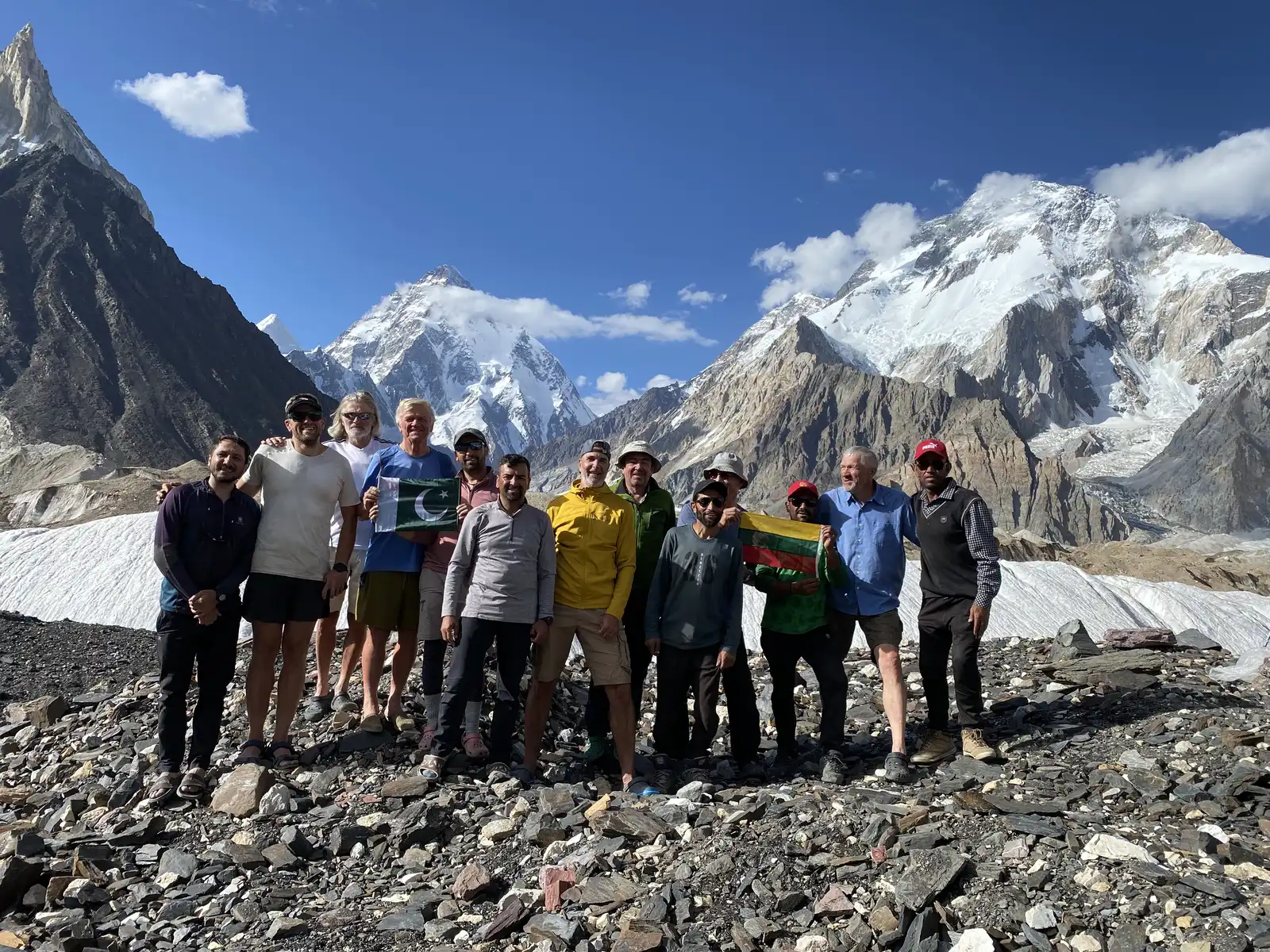
20 Days Trek Gondogoro La K2 Base Camp Pakistan
About this tour
20 days, 14 days very strenuous hiking at high elevation (maximum 5,600m) - 14 nights camping & 6 nights hotels
“The world’s greatest museum of shape and form” is how Italian mountaineer/author Fosco Maraini described Concordia in his book, Karakoram. In Concordia, six peaks over 7,925 meters rise to touch the heavens, including K2 (8,611 m) the 2nd highest mountain on earth. After visiting Islamabad, we fly to Skardu and then drive to the trail head and meet our colourful expedition porters, sturdy mountain men. As we trek up to this other-worldly place we enter a remarkable wilderness of ice, rock and sky. By the time we reach Paiju Camp at the foot of the Baltoro Glacier, we begin to feel the pulse of creation: the ice melts the rocks roll , and the glacier creaks and groans, rearranging its icy rivers. When we reach Concordia we are rewarded with the most incredible mountain views in the world, virtually surrounded by
K2 , Broad Peak (8,051 m), Gasherbrum IV (7,925 m), and razor- edged Mitre Peak. Our return trek is by way of the Gondogoro La (5,600 m) , a challenging hike skirting the Gondogoro Glacier, and down to the green irrigated fields
of the Hushe Valley. This is an exciting, challenging trek, geared for hikers with previous high altitude mountain trekking experience.
Day-by-day itinerary
Day 1: Islamabad Airport Road, Islamabad, Pakistan to Islamabad, Pakistan
Arrive Islamabad Spend the day in Islamabad finalizing permit details with the Ministry of Tourism. Evening free. Overnight at hotel.
Day 2: Islamabad Airport Road, Islamabad, Pakistan to Skardu Airport, Skardu
Travel To Skardu, In the morning you will be transferred to Islamabad airport for the flight to Skardu (2272m). This flight is subject to clear weather. Alternately, we take two-day drive to Skardu, along the Karakoram Highway, sometimes refereed to as the eighth wonder of the world. We stay overnight at Chilas on the banks of Indus, the lion river.
Day 3: Skardu Valley, Skardu
Explore Skardu Free day at Skardu, the capital of Baltistan, sometimes called little Tibet due to its geographic location and historic links with Tibet and Laddakh. Stroll down the narrow bazaar, climb up the cliff to visit the historic Kharpocho fort, visit the turquoise blue Satpara Lake which is just a few kilometres from the town. Meals and overnight at Motel/Resort.
Day 4: Kharpocho Fort, Skardu to Askole
Towards Trek Head We leave Skardu on metal road heading east, drive over a small pass and enter Shigar, a valley of orchards. Arrive at Askoli , and leave the jeeps for a short walk to camping site. Meals and overnight at camp. 6-7 hour jeep ride.
Day 5: Askole
Start The Trek As the staff distribute 25kg each among the porters, we start our trek in the soft morning light . Walking along the Braldu river we arrive at Askole , the last permanent settlement along the trek, often mentioned by early explorers as the last human inhabitation of the Indian subcontinent. Another three hours’ walk across barren wasteland brings us to Biafo glacier, a tortured sea of ice and rocks two kilometers wide at this point. It takes around two hours to cross the glacier on a established trail, walking most of the time on morraine and occasionally on ice. Once across the glacier it is twenty minutes to Korofan (10,200`). 6-7 hours.
Day 6: Askole Mosque, Askole to Askole School, Askole
The wooden bridge A tough day’s walk along a cliff face to arrive at the cable bridge to cross the Dumordo River. We may have to wait here for some time for our turn to cross the river over the newly built wooden bridge which replaced a swinging pulley. The last two hours are a comparatively easy walk beside the river. This section of the trek can be unexpectedly hot and dry, so protect yourself well from the sun. Our campsite Khrobrak (4242m) is a small stretch of land just by the Braldu river, which will provide natural music all the time. 7-8hrs trek.
Day 7: Skardu to Kharpocho Fort, Skardu
Greets You Near Paiju The trek starts in easy fashion with an occasional scramble over rock . Three hours’ walk brings us to the point where waters from the Paiju peak divide themselves into four rushing streams, that can be crossed by jumping over the stones and then walking through the meltwater. In the east dominating, the horizon are the towering summits of Gashabrum 4, Cathedral Towers and Broad Peak. After negotiating scree and sand, we walk along the river, arrive at Paiju (3560m), a refreshing campsite situated in a grove of willows and poplars through which flows a stream of fresh water. 4-5 hours trek.
Day 8: Skardu Valley, Skardu to Skardu
On Baltoro We begin our day’s trek with a walk for about an hour across gradually ascending barren territory to arrive at the snout of the Baltoro Glacier, a vast, turbulent sea of rocks and ice more than two miles wide and nearly forty miles long. The first stretch of the walk on the undulating glacier can be a little challenging as we dodge small crevasses. The view is magnificent with the Cathedral and Trango Towers, rising to 6000metre -plus on our left. We begin to feel the pulse of creation: the melting ice, the shifting rocks, and the groans of the glacier as it rearranges its icy rivers. As we walk across boulder-strewn ice, we gradually gain height over three hours to the south side of the glacier. We arrive at a flat, sandy area of lateral moraine, our campsite Khobursay at 4000m. 5-6hrs trek.
Day 9: Skardu Valley, Skardu
Biango We walk on the lateral moraine of the glacier for the first two hours. After arriving at the green pastures of Urdukas, we cross crevasses and then walk on the medial moraine of the glacier. The middle part of the glacier has its own surprises for us, small streams of water rushing over clear blue ice, and huge mushroom-like ice towers erupting from the glacier. As we proceed Gashabrum 2 (8035m), the 14th highest peak in the world) peeps from the right shoulder of G-4 in the east. Biango, at 4030m, is our campsite, dominated by a stunning view of Mashabrum (7900m) due south. As we are camping on a thin layer of moraine over glacial ice the night can be cold. 7-8hrs trek.
Day 10: Skardu
To Concordia ? Yes Concordia ! Start your trek walking on the medial moraine of the glacier to the incredible sanctuary of Concordia. As we make our approach , Gashabrum - 4 stands guard in the east. On our left we have magnificent views of Muztagh Tower (7200m) on the border between Pakistan and China. Excitement mounts and paces quicken as we arrive at Concordia, lured by the classic views of K2 (8612m), The second highest mountain of the world. Concordia - the meeting place of five glaciers, is named after “Place de la Concorde” in Paris. Within a radius of 15km are 41 peaks above 6500 meters, almost half of them still virgin and unnamed. Also visible from Concordia, clockwise from K-2 are: Broad Peak (8068m), Gashabrum 4 (7900m), Baltoro Kangri (7245m), Kondus (7000m), Mitre (6000m), Paiju (6610m), Crystal (6300m), Marble (6200m) and Angel Peak (6800m). 4-5 hour trek.
Day 11: Skardu to Skardu Valley, Skardu
K2 Base Camp Full day excursion to the base camp of K2. A strenuous 10-hour round-trip trek over snow, rock and ice. As we start our trek, we cross crevasses of the Baltoro Glacier, then walk on the lateral moraine of the Godwin Austin glacier to the base camp of Broad Peak. Chogolisa (7586m) now appears on the scene, standing guard in the south and hinting at the new crossing from Concordia to the Hushe valley. As we proceed towards base camp, we walk on the moraine of Godwin Austin glacier. Walking here is much easier than the first two hours’ stretch on rocks. When we arrive at K2 base camp at 5000m, which is normally occupied by five mountaineering expeditions during the climbing season each year, we are overwhelmed by the sheer size of K2. Return to Concordia for overnight.
Day 12: Skardu
To Ali Camp The first two hours of the trek are difficult as we leave Concordia and traverse the Baltoro Glacier and its crevasses. Once on the Vigne Glacier it is a comparatively easy and gradual walk over snow and ice. Mighty Chogolisa (7600m) stands guard in the south. Camp overnight at Ali Camp (5030m), a combination of small rocky platforms between the cliff face and crevasse. We turn in early, as we have a midnight wake-up call for the departure over the Gondogoro La. 5-6hrs hiking.
Day 13: Skardu Valley, Skardu to Kharpocho Fort, Skardu
Khuispan A rest day after the ascent of the pass. We can take time to explore the area or just relax and admire view of Laila Peak (6063m), Drangra (6230m, and Tasa Peak (6514m).
Day 14: Skardu Valley, Skardu to Hushe River Valley, Saling
Dalsangpa As we leave Khuispan, we make a long traverse of the Gondogoro Glacier, first encountering small crevasses, then hiking over the soft ice of the glacier. The last half hour is a pleasant stroll through wild flowers, with commanding views of the Gondogoro Glacier, Yermandu Kangri (7555m), Mashabrum South (7688m), and the Mashabrum La. Camp at 4198m by a small Lake. Three to four hours hiking.
Day 15: Hushe River Valley, Saling to Hushe
Saicho As we continue, we gradually leave the icy landscapes and descend to the meadows and pasture land at Saicho (3727m). Although we’ve left the icy wilds, we still have tremendous views, including Namika Peak (6230m), and Defokhar (6445m). Four to five hours hiking.
Day 16: Hushe River Valley, Saling to Saling bridge, Khaplu
Hushe Descend to the Gondogoro River, enjoying spectacular views of K-6 (7171m, K-7 (6839m), and Link Sar (6935m). We continue descending, passing through small summer settlements en route to the green irrigated fields at Hushe (3153m). Four to five hours hiking.
Day 17: Saling bridge, Khaplu to Skardu
Back To Civilization * Skardu Enjoy your last breakfast at the camp for this trek, and say Khuda Hafiz to your camping staff who had been pitching tents for you and preparing meals for you during the trek. Board soft top 4x4 jeeps for a bumpy ride through Karakoram. This part of Baltistan appears greener and more prosperous than on our drive to Thongol. Arrive at Skardu. Transfer to motel - and enjoy the hot shower. Meals and overnight at resort/motel. 5/6 hours jeep ride.
Day 18: Skardu Valley, Skardu to Naran, Pakistan
Towards Pindi * (Pindi/Chilas) We book the flight to Islamabad, with good luck the flight might operate, enabling us to arrive Pindi in just one hour (miracle of science!). In case of cancellation of flight, we shall drive by road to Islamabad - spending overnight at Chilas KKH.
Day 19: Skardu
Towards Pindi * (Pindi/Chilas) We book the flight to Islamabad, with good luck the flight might operate, enabling us to arrive Pindi in just one hour (miracle of science!). In case of cancellation of flight, we shall drive by road to Islamabad - spending overnight at Chilas KKH.
Day 20: Naran, Pakistan to Islamabad, Pakistan
Finally Back ! * Pindi Once at Rawalpindi, we shall proceed to the office of Ministry of Tourism for de-briefing of the trek. Day free to explore the twin cities of Rawalpindi and Islamabad. Day 21 _ Fly Home Transfer to airport for international departure flight
What's included
Cost Includes: Accommodation on twin sharing basis: at standard category hotels in towns. Meals: half board at hotels, full board during trek. Transport: Air conditioned transport in Islamabad, soft top 4x4 jeeps from Skardu to trek head and back. Camping facilities 2 Pax-dome tent with mattress, dinning tent with folding table & chairs, kitchen tent with complete kitchenette & staff, toilet tent. Portage of 15 Kg, of personal luggage during the trek. Trek Permits’ Processing & payment from Ministry of Tourism. English speaking qualified Mountain Guide.
Cost Does Not Include: Any domestic/international air fare. Personal trekking equipment, medicines and any expense of personal nature. Any expense due to forced majeurs, cancellation of flights, landslides, evacuation or accident or delay beyond the control of land operator.
Languages spoken
What to know
GEAR AND CLOTHING LIST For Trekking GEAR & Clothing While on an organised trek, it is best to pack all items for your trip in one large piece and one carry on. The large piece must be a duffel bag (weighing not more than 12.5 Kg.) because duffel are easier for porters to carry. A small day pack is suggested as carry-on to keep items that you will use during while on the trek, bus or jeep. Luggage Large duffel bag with lock. It is not recommended to put your stuff in backpack as the straps might get damaged while being transferred from bus to jeeps, jeeps to campsites and during loading and unloading by porters each day. A small padlock that fits through the zipper of your duffel bag is recommended. Day Pack. Large enough for camera gear, cap, sun glasses, water bottle, jacket and other items you may like to use while on the trek. Extra carry-on. For storing city clothes in Skardu. Money Belt. A small fanny pack, money belt or around the neck passport bag is suggested for keeping safe your passport, travel documents and money. Packing list for your Duffel. Sleeping Bag. As we shall be sleeping for four nights at Concordia at 4,700 meters or at Snow Lake and High Pass at 5151 meters above sea level, so the bag should be rated for 0 degree For -18 degree C. Ratings are all relative since the amount of insulation needed for a particular person to stay comfortable depends on their rate metabolism. A down bag will be warmer for its weight and pack smaller but does not retain its insulative properties when wet. A water proof breathable shell or a bivy-bag will keep the bag dry. A synthetic bag keeps you warm even when wet and is a less expensive alternative, but will weigh more for a given amount of warmth. Trekking Boots. The single most important item on this list. Never take brand new boots on a trek, make sure they are well broken-in before departure. Good trekking boots are hard to get in Pakistan. If you are buying a new pair from abroad, look for medium-weight boots of fabric or a fabric/leather combination. They should provide adequate ankle support . A vibrum or other deep-lug will protect you from rocks and add support. Always use thick socks when trying shoes so that you get the correct size. Short shoes can jam your toes painfully during steep descents. You could also try to get new “Grouted” shoes that provide protection against water and are good while walking in rain or through snow. Make sure you can fit crampons on your shoes, as it is vital for crossing different passes. Camp Shoes. Jogging shoes or sneakers to slip in at the end of the day. Tiva sandals are ideal for this trek, as you can use them while crossing streams and also at the campsite for strolls. Crampons You may need crampons on certain treks, sometimes only for one day. It helps in having better grip on hard snow to have crampons fitted to your boots. Look for easy to fix ones. ( Check with us for your specific trek if you need the crampons or not). From our regular trek list, you would need to bring crampons for : Gondogoro La, Biafo Hispar and Wartum Peak Thermal socks. The socks you wear are a critical element. A cotton/wool combination is useful while on the glacier, and for warmer conditions cotton socks are best. For hose who are sensitive to wool synthetic/cotton socks are recommended. Liner Socks. A thin, wickable material. Polypropylene, Capilene, Thermax and Drylete all work very well. Silk does not work nearly as effectively as any one of the above. Polyester Fleece/Pile Jacket or Pullover. Stays warm even when wet. Polyester Fleece Pants. Good for afternoon strolls, same as above. Rain gear. A rain suit available from the local market is best for rain, doubles as windbreaker, and fits over pile jacket and pants. Wicking Long Underwear (tops & bottoms). Wick moisture to keep you warm and comfortable and dry quickly. Two suits are a good idea. Ski Hat. Covers your ears properly, use one with cotton liner. Woolen cap is also good. Mittens or Gloves. Woolen gloves are useful when at higher elevations and during windy conditions, when temperature drops quickly. Brimmed Sun Hat. Very important for this trek, as when we start the trek and till we arrive at Concordia, we are generally walking towards east. This can be annoying in the morning as sun is low and hits your eyes. Bathing Suit. Men can take bath by the rivers or occasional lakes in ablation valleys. Toiletries. Keep everything you normally use. Just remember to bring effective sunscreen, chap stick /lip balm, skin lotion and laundry soap. CLOTHING With your knowledge of Pakistani culture you are well aware of precautions to be taken while traveling through remote areas. Cloths for the trek should be durable, comfortable and easy to wash and dry. In good weather you will spend much of your time in a T-shirt or medium shirt and outdoor trousers. You will need warmer clothes for evening in the camps. Temperature falls rapidly as soon the sun goes down. Men could wear shorts once we are through the populated areas, that means from the third day of trek. Women are advise to use cotton shalwar kameez (loose long shirts and baggy trousers) the traditional Pakistani dress, as these are comfortable during warm conditions, and also appreciated & respected by the locals. Check List Head gear Parka Wool shirt & trousers Sweater Cotton shirt & pants Gloves & Mittens Rain/wind suit Cotton & Wool undergarments Socks (Cotton & Wool/synthetic) Boots (Trek & Camp) Belt ! Down Jacket Shalwar Kameez (Cotton) Spare laces for boots Miscellaneous Items Sunglasses Towel Washcloth Bandanna/Scarf, for covering your mouth while riding in a jeep. Water bottle, with durable screw top. Sunscreen Headlamp with flash light + extra batteries and bulb Insect repellent Swiss Army knife, or a similar one Nylon cord for a clothes line Personal Medical kit Pocket size sewing kit Lighter or matches for general use Wrist Watch Optional Items Thermarest. We provide close-cell matrices but you may want to supplement for additional comfort. Stuff sacks of various sizes for storing of your used clothes. Toilet paper or travel pack of tissues. An interesting book. Note book and pen for journal. Snacks: personal choice of dried fruit, candy, energy bars. Binoculars. Camera, film, extra batteries, cleaning supplies and extra lenses. Sports gear (playing cards/Frisbee) Water purification tablets
Route & locations
Islamabad Airport Road, Islamabad, Pakistan to Islamabad, Pakistan