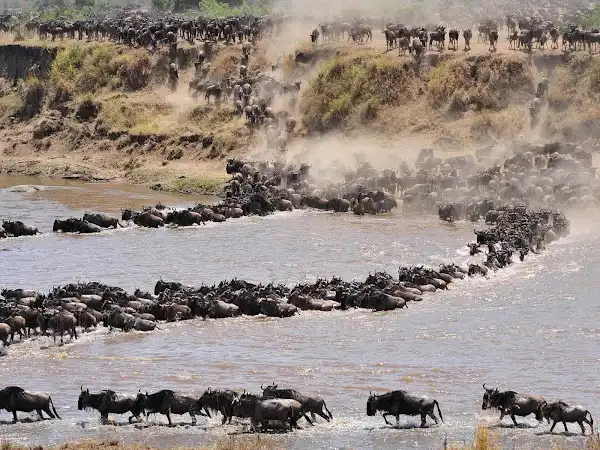
6-Day Great Wildebeest Migration, you will live witness with your own eyes one of the amazing wonders of the world in Serengeti National Park, where millions of wildebeest, zebras, and antelopes migrate naturally from Serengeti to Masai Mara and vice versa each year. Serengeti National Park is the biggest park in Tanzania and the host of the world's largest mammal migration of wildebeests, zebras, and antelopes. More than 2 million wildebeest, half a million zebras, and antelopes migrate to and from the Masai Mara in Kenya, searching for water and pasture. Additionally, you will also visit Ngorongoro Crater, where millions of different species form an amazing ecosystem on the crater floor.
The Great Wildebeest Migration
The great wildebeest migration is a natural phenomenon as old as the land itself and is truly a once-in-a-lifetime experience. Join us in the Northern Serengeti between July and October to witness the migration crossing the Mara River, or in Ndutu between December and March to witness the calving season. All of our wildebeest safaris are tailor-made and created just for you, so please contact us for a quote
Pick up from your Arusha Hotel and drive to Lake Manyara. Game viewing en route. Lunch at the lodge, followed by an afternoon game drive. Return to the lodge before dusk and your Dinner and overnight at a lodge.
Depart after breakfast to Serengeti, passing through Olduvai Gorge, the site for Leakey’s family discoveries of fossils of human and animal ancestors dating to almost two million years ago. Game viewing en route, with an afternoon game drive.Dinner and overnight at the lodge in the park.
A full day in endless vast plains of Serengeti National park, Enjoying a morning game viewing. The Serengeti is Tanzania’s oldest and most popular national park and is also a UNESCO World Heritage site. The Serengeti is a year-round destination and each season has its own special highlight with the most famous being the annual wildebeest migration which is a once in a lifetime experience. You will game drive enroute before arriving into the Serengeti in time for a half day game drive. After Lunch you proceed fo an afternoon game drive and your dinner will be served at your lodge overnight at lodge
Early morning tea or coffee followed by a morning game drive. After breakfast depart to Ngorongoro, which is among the seven wonders of the world, The Ngorongoro Crater. Dinner and overnight at a lodge on a rim of the crater.
After breakfast you will start descending 2000ft down the crater by using our 4wheel drive safari vehicle for a full day exploring the crater, Then you will have a break to enjoy a picnic lunch inside the crater. After lunch you continue with Exploring this magnific crater while concentrating on hundrends of games inside the crater.Then later this day you will ascend back to the lodge for dinner and overnight.
You will enjoy your breakfast in the restaurant at the lodge then visit Mto wa Mbua village to meet local people and late afternoon depart to Arusha or Airport.
Transfers in both directions between the International Airport and Moshi. One-night Hotel accommodation in Moshi/Arusha. Accommodation at luxury lodges and camps during the safari, full board Extended 4 x 4 safari jeep with pop-up roof for game viewing Professional safari guide Entrance fees to all national parks. Maasai Experience tour if interested. Ngorongoro Crater fees 18% VAT to our entrance fees. Government taxes, VAT and service charges relating to accommodation and included meals.
Tanzania Visa: $50 per person on arrival, USA and CANADA passport holders USD.100 Personal Expenses (e.g. laundry, telephone, beverages, etc.) Optional Tours (balloon rides USD. 570 per person) Tips and gratuities to your safari guide.
Best Time For Safari in Tanzania The best time to visit Tanzania depends on the wildlife you want to see. Tanzania’s seasons are shaped by the rains, offering unique experiences throughout the year. The Great Migration, the country’s main attraction, happens year-round across the Serengeti. From July to September, large herds of wildebeest and zebras cross the Mara River, facing crocodiles and other predators—a dramatic spectacle that draws many visitors. If you prefer a quieter experience, consider visiting during the “green season” from November to March. Although there are occasional rain showers, it’s the perfect time for birdwatching as thousands of migratory birds arrive. You can also witness the Great Migration herds with their newborn calves during this lush and vibrant time. Witness the Magic of the Serengeti Migration A Serengeti migration safari is a breathtaking journey into the heart of Africa’s wild beauty, where millions of wildebeests, zebras, and gazelles traverse the vast plains in search of fresh grazing lands. As the golden sun rises over the savannah, you’ll witness the thunderous movement of these herds, alongside elephants wandering peacefully, lions resting under acacia trees, and giraffes silhouetted against the horizon. This adventure not only brings you face-to-face with incredible wildlife but also offers a glimpse into Maasai culture, where you can learn about their traditions and harmony with nature. As the day fades, the Serengeti sky comes alive with stunning sunsets and a canopy of stars, adding a touch of magic to each evening. A migration safari with Twende Africa Tours is more than just a trip—it’s an unforgettable experience that captures the soul of Africa. Zebra-from-Above Serengeti-Migration-Safari-5 SAFARS (2) The Great Migration in detail When planning your Serengeti safari you probably want to include seeing the Great Migration. So how do you ensure to be there when it happens? The long and short of it is that you can’t. It is important to realize that the decision of when to visit the Serengeti always involves an element of risk. We have detailed the Great Migration below, and this is what usually happens, but keep in mind that there are no guarantees. The annual migration of two million ungulates, wildebeest but also enormous groups of zebra and Thomson’s gazelle, Grant’s gazelle and eland, through Serengeti National Park is the greatest wildlife spectacle of its type in Africa, and perhaps the world. Although variations occur from year to year, the Serengeti migration follows a reasonably predictable annual cycle, dictated by local rainfall patterns. The Great Migration cycle breaks up into the following periods: GETTING A VISA IN TANZANIA To visit Tanzania, you need a valid passport (at least 6 months beyond your stay) and a tourist visa. You can apply for a visa online before your trip or get one upon arrival at Kilimanjaro International Airport. However, getting it in advance is recommended to avoid long queues and potential delays. Visas typically cost around $50, although US citizens may pay $100. UK, US, Australia, New Zealand, Canada, India, and most EU citizens need a visa to enter Tanzania. You can also apply online at Tanzania eVisa. Make sure to read the guidelines and ensure you are entering through an approved entry point. Where to obtain a Tanzanian visa In Dar es Salaam: The Office of the Director of Immigration Services In Zanzibar: The Office of the Principal Immigration Officer Abroad: Any Tanzanian Embassy or High Commission or via the Tanzania Immigration Services website Entry points to Tanzania: Any gazette entry point, including international airports, Zanzibar Airport, the port of Kigoma, Horohoro, Sirari, Tunduma, and Nagama Please be advised that, whilst we make every effort to provide you with accurate and up-to-date information, travel requirements can change quickly and sometimes without notice. We urge you to double-check the visa and passport requirements for your trip, and consult with an embassy or consulate.
Arusha, Tanzania to Lake Manyara, Tanzania