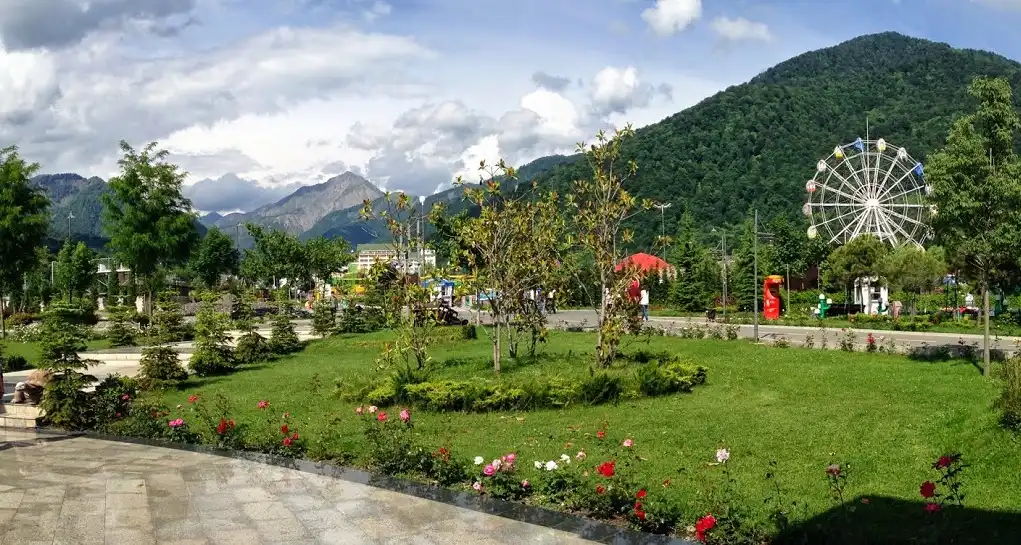
Flavors And Legends Of Azerbaijan
About this tour
Embark on a journey from the dazzling streets of Baku to the serene mountains of Gabala and the historic charm of Sheki. Explore ancient mosques in Shemakha, wander lush forests and waterfalls in Guba, and immerse yourself in the vibrant culture, exquisite cuisine, and warm hospitality of Azerbaijan.
Why You’ll Love This Tour:
Iconic Sights: From Baku’s futuristic skyline to Sheki Khan’s Palace.
Nature & Adventure: Mountains, forests, and hidden waterfalls await!
Cultural Immersion: Authentic experiences in villages, markets, and traditional homes.
Comfort & Convenience: 9 days, 8 nights of perfectly planned travel.
Create memories, capture breathtaking landscapes, and experience the heart of Azerbaijan like never before!
Day-by-day itinerary
Day 1: Baku International Airport, Azerbaijan to Baku, Azerbaijan
Meeting at the airport. Accommodation at the hotel in the city Free Day
Day 2: Baku, Azerbaijan to Icherisheher, Baku, Azerbaijan
09:00 Breakfast at the Hotel Excursion. "Baku City Tour". The tour begins with a visit to one of the modern and most recognizable places of the "Heydar Aliyev Center". The center of Heydar Aliyev is a cultural center, which is a complex building, which includes an auditorium (congress center), a museum, exhibition halls, administrative offices. The famous architect Zaha Hadid designed the project of the centre. Baku is a city that combines modern and ancient, traditional and unusual. After inspecting the сenter, we are on our way to the Nagorny Park. It is here that the "City of Winds", as Baku is often called, opens to you in all its glory. The observation platform located on the highest part of the city, near the sleeping "The Languages of Flame" shows the city with all its beauties and greenery bordering Baku Bay. After viewing the observation deck, we go down the stairs and head towards the "Bibi Abyat Mosque". Bibi-Heybat Mosque (Azerbaijan's Bibiheybət məscidi) is a mosque located on the shore of Baku Bay, in Azerbaijan. The existing structure, built in the 1990s, is a reconstruction of the mosque of the same name, built in the 13th century by Shirvanshah Abu-l-Fath Farrukhzad and destroyed by the Bolsheviks in 1936, when a fierce struggle with religion was going on throughout the territory of the USSR. The Bibi-Eybat complex, in addition to the mosque, includes tombs and tombs of revered people (including the grave of Ukeima Khanum, the descendant of the Prophet Muhammad), as before destruction, and today is a spiritual center for Muslims of the East and one of the significant monuments of Islamic architecture of Azerbaijan. The mosque was once visited by Abaskuli-aga Bakikhanov, Alexander Dumas, Khurshudbanu Natavan. The local population in the past called it "the mosque of Fatima". Using the same name, described the mosque and visited it in the 40 years of the XIX century, Alexander Dumas. At the end of the modern Baku tour we visit the world's first oil well drilled in the Bibi-eibat oil-bearing region. Visit to the old town of Icheri Sheher Very often Icheri Sheher is called a fortress, as a well-preserved fortress wall surrounds it. People in the territory of Icheri Sheher lived in the Bronze Age, and by the 8th-11th centuries, it was completely populated. Behind the walls, there are many unique monuments: the palace complex of the Shirvanshahs with a burial vault, a sofa, a mosque; "Gyz Galasy" ("The Maiden's Tower"); mosques and minarets, the remains of caravanserais, baths. Buildings of the old fortress are of a special nature. Because of the lack of the territory of the building, the wall to the wall was erected here from ancient times. There are no gardens, the yards are extremely small and separated by "threads" of narrow streets, lanes and dead ends. Built - the Palace of the Shirvanshahs. It should be noted that Baku XVII-XIX centuries did not go beyond the boundaries of Icheri Sheher. Here were located the palaces of the rulers, and residential quarters. From 1747 to 1806, there was the capital of the Baku Khanate. Only after the beginning of the oil boom, the city began to expand and goes beyond the boundaries of Icheri Sheher. The fortress wall itself is of interest. Once Baku had two of them, and they were separated by moats, but at the beginning of the XIX century, the city grew so fast that it was necessary to demolish and build the outer wall. Remained only the inner wall. It has 25 towers and 5 gates. They say that back in the 30s. Twentieth century in the fortress there were more than 900 buildings, and by the beginning of the XXI century only half remained. Overnight at the hotel.
Day 3: Baku, Azerbaijan to Yanar dağ, Baku, Azerbaijan
09:00 Breakfast at the Hotel Excursion. "Fire worships Temple Ateshgyah + Burning Mountain Yanardagh". The Temple of Eternal Fire - Ateshgyah - is an authentic Azerbaijani exotic. It is well-known practically all over the world. It is located 30 km from the center of Baku in the suburb of Surakhany. This territory is known for such unique natural phenomenon as burning natural gas outlets (underground gas coming onto surface contacts oxygen and lights up). The temple in its present state was constructed in the 17th-18th centuries. The Baku-based Hindu community related to Sikhs built it. However, the history of the Temple is even longer. From times immemorial, this was the holy place of Zoroastrians- fire worshippers (approximately beginning of our era). They attributed mystical significance to the inextinguishable fire and came there to worship the relic. After the introduction of Islam Zoroastrian temple was destroyed. Many Zoroastrians left to India and there continued their worship. But in the 15th -17th centuries the Hindus-fire worshippers who came to Absheron with trading caravans began to make pilgrimages to Surakhany. The Indian merchants started erection of the temple. The earliest temple part is dated 1713. The latest - the central temple-altar was built with the support of merchant Kanchangar in 1810. During the 18th century chapels, cells, a caravanserai were added to the central part of the temple. On у can find carved inscriptions in Indian lettering there. In the early 19th century the Temple acquired its present-day appearance. Ateshgah is a pentagonal structure with a castellation and entrance portal. In the center of a yard the altar-sanctuary executed in the form of a stone bower on which angles some more centers are located towers. In the center of an altar - a well from which beat "eternally" burning gas. Burning Mountain Yanardagh One of the most famous and popular tourist places of the "eternal flame” in Azerbaijan is the mountain of Yanar Dag. Actually, it is rather a hill than a mountain, with natural gas burning on its slope from ancient times. Meter-long tongues of fire are licking the stratified earth approximately for 10 m in width, searing those who approached too close. People occupy the benches to watch the blazing hill in the evening, when the its sight is most effective. Yanar Dag is located 25 km to the north from Baku, in Mehemmedi village. There are buses running to it from the city, so you can get there fairly cheap and easy. From the year 2007, Yanar Dag is declared a state-protected conservation area. 19:00. Excursion. "Lights of the Evening Baku". Tour "Lights of Evening Baku" begins with a visit to Mountain Park. It is here that the "City of Winds", as Baku is often called, opens to you in all its glory. The observation platform located on the highest part of the city, near the "Burning Flame Tower" shows the city with all its bright lights bordering Baku Bay reflecting the measured pace of life in the evening Baku. Further, we continue our excursion to one of the favourite places of the walk of the Baku guests of the city of all ages and social groups, a place where no one is in a hurry in the evening - "Baku Boulevard". The national park, sometimes called the "diamond necklace of Baku", stretches along Baku Bay for 16 km. At each time of the day the boulevard has its charm - in the morning you can walk in silence, feel unity with nature, go in for sports, during the day, especially on weekends, the boulevard is fully revived thanks to the small inhabitants of the capital, riding on attractions, rollerblades and bicycles, in the evening it turns in the magical world of dreams for all lovers. In addition, the original illumination and illumination of the park, fountains and other innovations give our boulevard a special charm. At the end of our excursion "Lights of Evening Baku», we will go to the most lively and central street of the city of Nizami "Torgovaya street" as it is also called from the old times. Trading is the longest of Baku's streets (its length reaches 3.5 km). It is also called the most beautiful street in Baku - it has a large number of architectural monuments, beautiful houses, cinemas, parks, many modern boutiques and shops. Transfer to the hotel and free time
Day 4: Baku, Azerbaijan to Gobustan Rock Art Cultural Landscape, Qobustan, Azerbaijan
09:00 Breakfast at the Hotel Excursion. Reserve of rock carvings Gobustan. The reserve is located 60 km from Baku and is located between the slope of the Great Caucasus Ridge and the Caspian Sea. Gobustan is an open-air reserve reflecting the life and everyday life of primitive people who lived here since the Mesolithic period until the Middle Ages. A special place is occupied by ancient rock carvings pictograms and petro glyph petro glyphs. These ancient monuments of art reflect the worldview, economy, customs and traditions of ancient Azerbaijanis. Gobustan is characterized by male and female images. Men in the drawings are depicted in a hunting appearance with bows and arrows. They are tall, with slender bodies, belted Belts and muscular muscles. On the pictures of the Reserve, you can see pictures of animals that lived here during the last 10 thousand years - gazelles, wild goats, deer, wild pigs, horses, lions, etc. On the rocks, there are also images of birds, fish, snakes, lizards and various insects. Ancient rock carvings along with a variety of topics abound in compositional scenes, reflecting in all the diversity of various spheres of human activity. They were reflected in the Azerbaijani dance of Yally, collective labor, hunting with various weapons, swimming on a Tigris-type boat, reaping of animals, attack of predators on herbivores, etc. Perhaps Yally was performed to the sound, published by the oldest musical instrument "Gavaldash" (a stone with a deep resonating sound). Before the start of the tour of Gobustan, we are waited by a visit to the museum of the same name that was recently built and is distinguished by its high technological level. Excursion to Mud Volcanoes. After that you will also have a chance to visit quite a unique site where 300 of the planet's estimated 700 mud volcanoes sit Gobustan, Azerbaijan and the Caspian Sea. Many geologists as well as locals and international mud tourists trek to such places as the Firuz Crater Gobustan Salyan mud tourists trek to such places as the Firuz Crater, Gobustan, Salyan and end up happily covered in mud which is thought to have medicinal qualities. In 2001 one mud volcano 15 kilometers from Baku made world headlines when it suddenly started spewing flames 15 meters high. Transfer to Baku Overnight in hotel
Day 5: Baku, Azerbaijan to Sheki, Azerbaijan
07:00 Breakfast at the Hotel Excursion: "Cultural Wonders of Shemakha, Lahij & Gabala". Shemakha is an ancient Azerbaijani city. Founded in the 5th century BC, it was the capital of the Shirvan Kingdom and the residence of the Shirvanshahs from the 9th to 16th centuries, making it one of the most beautiful cities in the East. Since the mid-18th century, it has been the center of the Shemakha Khanate. For a long time, Shemakha was one of the most important points along the Great Silk Road. This explains why the city was long a center of the Shirvan-Absheron architectural school and the school of decorative and applied arts (carpet weaving) and miniature painting. Juma Mosque. This Azerbaijani mosque is the oldest and largest in the Caucasus. According to legend, it was founded in the 8th century, when Shemakha was chosen as the residence of the Arab caliph. The exact date of its construction is 743, as determined by research conducted by a geological commission led by Prince Shakhguli Qajar, who arrived from Tiflis. This date was determined by an Arabic inscription on the Juma Mosque's façade, indicating the year 126 of the Islamic calendar as the founding date. Lahic. Lahic is a village named after the Lahic tribe that arrived here from Iran in the 4th and 5th centuries. This historical and architectural monument was built in the 5th century on the canyon of the Girdimanchay River. Ancient mosques and baths, as well as medieval aqueducts and sewer systems, have been preserved here. Despite the village being designated a historical and cultural reserve, it is still inhabited by a local population engaged primarily in handicrafts: the making of elegant household items from copper (cauldrons, trays, jugs), leather, carpet weaving, and agriculture. Tour: "Gabala – a land of forests, churches, and mountains." Gabala's history spans approximately 2,000 years. Much has changed here during this time. Gabala's climate is significantly influenced by the proximity of the Caucasus Mountains and the abundance of mountain rivers. The city is surrounded by the highest mountains of the Caucasus – Bazar-Yurt, Bazar-Duzu, and Tufandag. Gabala and its surrounding area are located in three climatic zones: in the north, mainly alpine and subalpine meadows; further in, mountain forests (primarily oak, hornbeam, and beech). The "Seven Beauties" waterfall is located near Gabala, near the village of Vandam. The waterfall consists of seven cascades, hence its name. If you want to admire this natural wonder, you should arrive very early. The waterfall is a pilgrimage site for tourists from all over the world; its base is usually packed with cars and buses, and the narrow wooden staircase is always crowded with admiring spectators. Tourists are only allowed to climb up to the fifth step; only the brave dare to climb the fifth, sixth, and seventh steps. Lake Nohur stands out among these places for its beauty. Nestled among picturesque mountains covered in lush green forests, it reflects its surroundings like a mirror in the hills of the Greater Caucasus. Nohur is a hidden gem of Gabala, located just 3 kilometers from the regional capital, the beautiful and culturally blessed city of Gabala. Excursion to Nij (Udi Village) The largest village in the Gabala district, Nij, is located 40 kilometers southwest of the district center. The village, with a population of approximately 4,000, is home to the Udis, an ancient Christian people. The village consists of several neighborhoods: Chotari, Agdalakki, Goja Beyim, and others, some of which retain ancient Albanian churches. One of these, the 17th-century Chotari Church, is still in use today and is the pride of the villagers. The village of Nidzh is also home to an ancient cemetery dating back to the 16th and 17th centuries. Departure to Sheki Overnight at a hotel in Sheki.
Day 6: Sheki, Azerbaijan to Baku, Azerbaijan
08:00 Breakfast at the hotel. Excursion. "Taste the Sheki Halva". Sheki is one of the most famous and ancient settlements of Azerbaijan. It is located 700 m above sea level and as an amphitheatre is surrounded by mountains. This ancient city has long been known as the center of silk and an important transit point on the Great Silk Road. We will begin our tour to Sheki with a visit to the Summer Palace of Khan with magnificent frescoes and exquisite handmade window decorations. Then we will visit the workshop, where we can be acquainted with the process of manufacturing "Shebeke" by local artisans. Next, we will visit the workshop for cooking the delicious "Sheki Pahlavas", famous throughout Azerbaijan. Excursion to Kish. Our acquaintance with Sheki continues with a visit to the Albanian church, which is located in the village of Kish. According to the legend, this church is the first Christian church built not only in the territory of Caucasian Albania, but in the whole of Transcaucasia. This place is also remarkable, as burial places of people were found on the territory of the temple, which in their structure are very different from the current inhabitants of this region. In 2003, the church was restored to the money of the Norwegian government thanks to the personal efforts of Tour Heyerdahl. Here, next to the territory of the Church, you can find a memorial bust, in honor of a famous researcher set as a token of gratitude from local residents and the state. Excursion to Ilisu - SULTANS GARDEN WITH WATER AROMAT This region of Azerbaijan is a treasure trove of historical and natural sights, it is necessary to write books about it, to dedicate epic poems, to compile encyclopedias; one article can not cope with a description of all that can and should be seen in the vicinity of Gakh. Therefore, we will not talk about the district, but we will talk about the village of Ilis with its rich history, which stones of fortresses, which have remained since the Middle Ages, still tell. In the village of Ilisu there are several historical architectural monuments - for example, the juma mosque, which differs from all previously seen mosques by its minimalism, the absence of a dome and a minaret, modesty in performing mihrab. In Ilis there are two more sights of this kind that you will meet along the road: the fortress of Syangar Gala and Sumug gala. The fortress of Syangar Gala (Shamilin Galasy) is named so in honor of the famous imam, the leader of the mountaineers of the Caucasus. According to the story, the inhabitants of Ilisu themselves appealed to him for help in the fight against the Russian Empire, and the fortress is a living witness of those years. In order to see it well, you will have to climb a small crest on which it is located. Departure to Baku Overnight in Baku.
Day 7: Baku, Azerbaijan to Quba, Azerbaijan
08:00 Breakfast at the hotel. 08:30 Excursion. "The secrets of the Kingdom of Shabran." The Red Mountains are a psychedelic, red-pink and white striped area of exposed rock in the Northwest of Azerbaijan. Iron in the ground gives the mountains their deep red color and powdery shale makes up the white parts. Through a geological process, they have mixed together underground, layer on top of layer, and when exposed to the elements, they eroded into a beautiful, completely bizarre sight. Despite being such a striking natural wonder, almost no one visits them. Though there are a few small trails to be found, the entire area is yours to play around in. If you are willing to hike away from the road, you are rewarded with crazy looking patterns that stretch for miles. Climb over whatever you want, take as many pictures as you can and explore all the small crevices in between. Though the main area exists just off the road, there are plenty of other candy-striped areas in the surrounding valleys. Occasionally in the rocks, one can see the fossilized remains of belemnites, a type of ancient squid. Unlike modern squids, this one contained a skeleton, most notably its bony rostrum, a hard protrusion on the opposite end from their tentacles. It is believed that a similar geological phenomenon happens only in one more place on the planet: the Death Valley in the United States. The formations themselves take their colour from ground water that has oxidized iron within the rock. Beshbarmag on the route. Here is one of the main natural attractions of the area – the legendary mountain Beshbarmag. Named so because because of its unusual shape resembling a stone hand menacingly raised over the ancient caravan route. At the top among the teeth of the rocks are the ruins of the sanctuary “Hyzirzinde” (eternally living Hizir). Any traveler knows this place because it can’t be avoided while driving on the road leading from the capital to the north. And tourists enjoy admiring the forbidding rock. You can exit the car, warm up after a long journey, drink tea, eat barbeque or boiled corn in season. Those interested can visit the mosque here. There are many historical monuments in the area. Beshbarmag tower built in the middle of VIII century is located at the distance of9kmfrom the center of the district. Excursion to Chirag Gala Castle Chirag Gala (“Lamp Castle”), a castle from 4th-5th century is located 100 km to the north of Baku on top of a mountain. Chirag Gala was built over a seam of oil and gas which allowed for lighting up signal fires visible to the distance of several dozens of kilometers. Similar castles and towers were located all over the area from Derbent to Baku providing for a warning system against enemy invasions. Today, under the castle, the “Galaalty” urology treatment center is located whose thermal water has a curative effect on diseases of the kidneys, urinary tract and digestive organs. Arriving in Guba Overnight in hotel
Day 8: Quba, Azerbaijan to Baku, Azerbaijan
08:00 Breakfast at the hotel. 08:30 Excursion. "Glorious Guba Khanate". Guba district has long gained popularity among tourists due to its proximity to the capital of Azerbaijan. In Guba, the symbol of which is the ruddy apple, beautiful nature, a large number of historical sights and a carefully protected cultural heritage. Guba carpet weaving school is known all over the world, and the hospitality of the locals is famous throughout the country. The region, which was visited by French writer Alexandre Dumas and Norwegian scientist Thor Heyerdahl, is ready to share his secrets with curious travelers. Walk along the arched bridge The only surviving bridge, called the Gudyalchay Bridge, is one of the seven that existed in the Guba district in the 17-19 centuries. This longest bridge was built in 1894 by the project of Alexander III in order to strengthen Russia's military presence in the Caucasus. Fourteen of its spans with a total length of 275 meters and a width of 8 m are made of baked bricks. The multi-span construction allows the bridge to remain intact even during heavy mudflows and floods that raise the water level in the river. A bridge of similar construction built in the 19th century is the only one in Azerbaijan. Visiting Krasnaya Sloboda village This village is a place of compact residence of Jews in Azerbaijan. The inhabitants of the Krasnaya Sloboda (Red Sloboda) village are mountain Jews, who call themselves “Dzhugur”. They speak Hebrew, but also knows Azerbaijani and Russian. Currently, about 4-5 thousand people live here. The inhabitants of the Red Sloboda are engaged mainly in trade. The local population loves pomp and in this wealthy settlement, you can see many fashionable mansions. Admire the Juma Mosque In the very center of the city, near the central park, there is one of the oldest mosques in the city - the Juma Mosque (Friday Mosque), built at the very beginning of the 19th century. Featuring a rich architectural style, the mosque was built of red brick in 1802 with the financial support of Haji Ismail Efendi. The architecture of this religious building is typical only for the mosques of the Guba province. Juma Mosque is one of the oldest religious centers not only in Guba, but also in all of northeastern Azerbaijan. Get acquainted with the historic bath The baths in Azerbaijan at all times occupied a special place in the life of people, being a favorite place for the enjoyment of body and spirit. The Guba bathhouse, built of red brick in the 18th century, is crowned by a large dome, which allowed the room to maintain the desired temperature and humidity. This quadrangular structure is also called Suhur (Chukhur) hamam, i.e. bath built of special rocks. The bath has 6 compartments, 2 doors and 6 windows. At one time, the French writer Alexander Dumas bathed in this bath, and 150 years later his great-grandson visited these places. Until 1985, the bath was used for its intended purpose, but now this pearl of Oriental architecture is protected as a historical monument. Gachresh Forests This is the most popular recreation area in the Guba district, located 25 km from the district center. Gachrash means come and sit down. This toponym is also interpreted as “a place where sunlight does not fall”. In this vast area, trees grow so densely that indeed the sun's rays do not reach the ground and in summer, it is pretty cool here. In winter, these places are covered with a thick layer of snow. Once the center of attraction for tourists was the suspension bridge located here - Asma Korpu, across the Gudyalchay River, now destroyed, but there is hope for its speedy restoration. On the very outskirts of the territory of Gachrash there is a natural formation called the Minara - in the form of natural minaret. The length of this natural monument is 30-35 m, width - 4-5 m, and height - 3-4 m. It is assumed that it was formed in the IV century as a result of tectonic movements and river erosion. The Minara also plays the role of a natural bridge at a height of 10-15 m. The small cave between the rocks is called the “fridge”. Indeed, it is so cold here that the owners of a nearby restaurant attached doors to the entrance, hung the lock and used the resulting room as a refrigerator. Visit the ancient Khinaligh village On the territory of Guba, 65 km from the district center, at an altitude of 2500 m above sea level, is located the unique village of Khinaligh. It has about 380 houses and 3,000 inhabitants. The population of the village is a separate ethnographic group and speaks its own language, which no one else in the world speaks. Together with the language, the Khinaligans also retained their ancient customs. There are always a lot of foreigners here - travelers and scientists who study the unique way of life and traditions of the original nationality. Departure to Baku Overnight in hotel
Day 9: Baku, Azerbaijan to Airport, Baku, Azerbaijan
09:00 Breakfast at the hotel. Free time to visit the eastern market, shops with sweets and souvenir shops. Transfer to the airport
What's included
Included Services Accommodation in 4-star hotels in a double room, based on breakfast. Transfers and transportation according to the program. Excursions as per the itinerary. Services of an English-speaking guide. Entrance tickets to museums and cultural sites included.
Excluded Services Lunch: from USD 15 (soft drinks included) Dinner: from USD 20 (soft drinks included) Single Room Supplement: USD 199 per tour Visa Fee: USD 40
What to know
Visa upon arrival at international airports of Azerbaijan can be obtained only by citizens of Turkey, Israel, Qatar, Oman, Saudi Arabia, Bahrain, Kuwait, Japan, China, South Korea, Malaysia and Singapore. For citizens of Russia and the CIS (except for Turkmenistan), a visa is not required to Azerbaijan. Citizens of other countries must obtain a visa prior to arrival, through the consulates of Azerbaijan in their country or to issue an electronic visa through our travel agency. To apply for a visa, contact our managers at least 4 weeks before arriving in Azerbaijan. Local currency: Manat The recommended currency for the exchange is: USD or EURO. Where to exchange currency: Upon arrival at the airport, the guide will provide accurate information on where and how to exchange cash for local currency. Availability of ATM: Only in large cities. Accept credit cards: Only in large cities. This tour can be customized. Please get in touch with me.
Route & locations
Baku International Airport, Azerbaijan to Baku, Azerbaijan