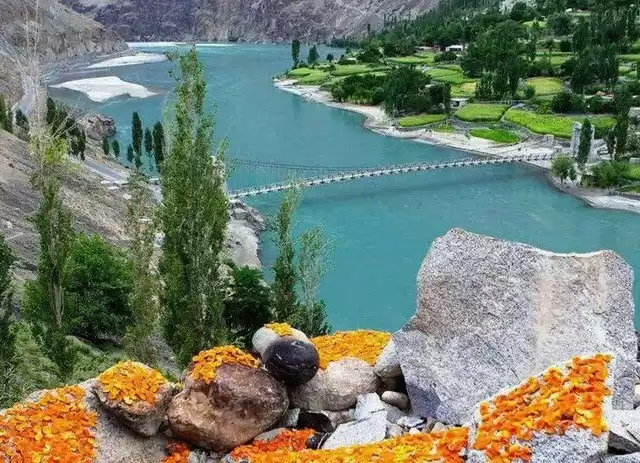
Gilgit Baltistan Autumn Tour - 14 Days
About this tour
Architecture, Culture, People, History
The expedition will be difficult, but incredibly beautiful. The complexity of such a journey is that we spend two weeks on the road. Most of the expedition runs along mountain serpentine roads, with a large number of high mountain passes. We will spend the night in simple hotels, lodges and tents. The food is quite monotonous. It will be hot and dusty.
Before deciding to go to Pakistan, each of you must understand that here you will not be “tourists”, here you will be a guest. Here you go to dispel your own stereotypes and myths about this country.
Now for the goals of our expedition! In Northern Pakistan, different and absolutely different landscapes are collected. It is amazing that on such a small piece of our planet almost all the highest mountains of our vast world are collected. We will see the icy, sparkling Nanga Parbat (8125 m), we will meet the sunset while admiring its reflection in the lake. Let’s touch the sky-blue, transparent and incredibly tasty water of the lakes and channels of Pakistan. We will visit the ancient forts, which are more than 1000 years old. We will see the vanishing point of the 3 most majestic mountain ranges in the world: Gindokush (Afghanistan) Karakoram (Pakistan) and the Himalayas (India), go to the protected area of the Deosai Plateau, which occupies a special place on our list of spectacular places in Pakistan. Deosai is translated from the local language as “summer home” and is the second largest plateau in the world after Chang Tang in Tibet. In the valley of the Hunza River, we will capture the rocky road of the Silk Road. Let’s take a photo of a huge number of the most beautiful and unusual, absolutely cosmic mountain landscapes, which we will begin to miss, not yet parting.
Day-by-day itinerary
Day 1: Islamabad, Pakistan to Gilgit
Arrival at Benazir Bhutto International Airport at 04:00 in the morning. Approximately 1 hour of visa formalities. Receipt of baggage. Transfer to domestic flight at 10:30 a.m. to Gilgit. Getting ready, the day will be long. Upon arrival in Gilgit, we change to our jeeps and leave for the Fander Valley (4 hours drive). Hotel accommodation.
Day 2: Gilgit to Phander Valley
Early breakfast. Today we go to one of the most beautiful corners of Northern Pakistan – the Shandur Valley, located between the Chitral region of Khyber Pakhtunkhwa province and Gizer Gilgit-Baltistan region. It is often called the “roof of the world.” This incredible beauty of the valley can be crossed exclusively during the period from the end of April to the beginning of November, as the rest of the year the level of snow here rolls over. Here, at an altitude of 3,700 m, an annual polo festival is held annually in early July, which is organized by the Chitral districts and the Ministry of Tourism of Gilgit-Baltistan. In 1935, British administrator Evelyn Ai Cobb ordered a huge polo area in Shandur Late in the evening we arrive in Gilgit. Check in at the hotel, have dinner. This will be our transit point to the long-awaited Hunza.
Day 3: Gilgit to Hunza, Hunza Nagar
Early breakfast. Transfer 3 hours to the Hunza Valley. Today is an easy day, we will go to the ancient forts Altit and Baltit, which are more than 1000 years old. We will walk along the streets of the most comfortable town of Northern Pakistan and we will meet the sunset in the Eagle’s Nest with a beautiful panoramic view of the entire mountain valley with its seven thousand meters high. The Hunza Valley is located northwest of the Hunza River, at an altitude of about 2500 meters. This is the main city in the region, in addition to breathtaking landscapes, two amazing forts are built here. People are cheerful, affable, fair-skinned and with blue or green eyes. Almost everyone speaks of Brushaski, and in the upper Hunza on Wahi. There are legends about the longevity of the locals, but the miracle of longevity of the hunzakuts is supposedly the result of their predominantly vegetarian diet of grains and fruits from the Hunza Valley. Baltit Fort: The fortress occupies a strategic position in the Hunza Valley, the military garrison controlled the seasonal trans-Karakorum trade between South and Central Asia. The Hunza rulers used the fortress as their residence until 1945. Work on the restoration of the fortress, carried out in 1990, showed that the main structures of the fortress (defensive structures and a stone tower) were built in the VIII century BC. e. The stone tower was supplemented by defensive structures connected to each other by a single passage consisting of small rooms and underground storage rooms. The complex was then expanded by adding a second and third floor. The stone structures of the wall, built in the region of frequent earthquakes, were further strengthened by wooden supports. The majestic historic Fort Altit is a center of attraction due to its architectural design and strategic location. The birthplace of the Kingdom of Hunza, the Fort was built in six different stages using various natural rock levels. The construction was done right on the edge of a sheer cliff that falls 1000 feet straight down to the Hunza River. At the beginning it was built as a palace, and soon after the addition of a watchtower, a defensive architectural element, it turned into a fort. There is a high probability that the various stages of the fort were built at different times, because the actual age of the fort is said to be more than 800 years. This fort is believed to be about 50-100 years older than Baltit Fort.
Day 4: Hunza, Hunza Nagar to Attabad, Pakistan
Breakfast. Having slept and peppy, we leave towards Gulmita, on the way we stop at the emerald-turquoise lake of the valley – Attabad Lake. Enough admiring the rocks, daredevils can swim in the lake. When the street temperature is 20-22 degrees, the water temperature will be about 10-12, – it refreshes at the moment. Having walked and, if desired, having a ride in small wooden boats, we are going to dine in a restaurant with national cuisine, where we will try shubut baat and chilpindok. After lunch, we head to the incredibly beautiful cone-shaped mountains of Pakistan – which have long been a hallmark of these places. They are often referred to as Passu Cones or Passu Cathedral. We are going to meet the sunset to the Hussaini suspension bridge. Lake Attaabad. In January 2010, a huge landslide descended in Hunza just 35 km to the village of Passu, it blocked the Karakoram highway and the Hunza river, after which an incredibly beautiful artificial lake formed – 35 km long, in the upper Hunze. The Hussaini Bridge is a long suspension bridge on the Hunza River. For us it will be an opportunity to get a portion of extreme sensations. The bridge sways and sways from the wind, the distance between the boards is 30 centimeters, and the Hunza River quickly carries its cold waters below. It is believed that in order for the bridge to have less “windage”, the distances between the boards were specially increased during construction. Indeed, the winds in these places are very strong. The previous bridge was torn down during the monsoon storm in 2011. And I must say, even despite the fact that the current (third) bridge is slightly lost in extremeness, because made more reliable, wide and comfortable, but the feeling of flying in the wind still remains almost off-scale.
Day 5: Passu Cones, Hunza Nagar to Gilgit-Baltistan Monument, Gilgit
Late breakfast. We leave for the lake Borit Lake, a short trekking to the glacier. After lunch, we return to Gilgit (3 hours transfer). Check in hotel. Dinner. Gilgit is the capital of the province of Gigit-Baltistan, it is a prosperous border town that has expanded rapidly to include about 35,000 inhabitants since the opening of KKH in 1878.
Day 6: Gilgit to Fairy Meadows Cottages
Early breakfast. The day has come when we set off for the most desirable and incredibly beautiful point on our route. We go to a place called Raikot bridge, where we exchange our beautiful cars for Pakistan’s all-terrain cross-country vehicles. We climb them along a winding narrow rocky road for about 3 hours to the start of tracking. From the grandiose landscapes around will be breathtaking more than once. We arrive in the village of Tatu Village. We give our things to the porters and go trekking to the base camp of Nanga Parbat (3 hours crossing). From there, climbers begin their ascents to the Summit. The very first attempt to conquer the great eight-thousander – the killer mountains Nang Parbat, was made in 1895 by the British climber Frederick Mummery, who also died at that time. Following were six more unsuccessful attempts made by various expeditions, and only in 1953 Hermann Bühl, a member of the German-Austrian expedition, alone reached an altitude of 8125 meters. Check in at the lodge. We meet the sunset with coffee and a view of the peak of Nanga Parbat burning in the sunset rays. Dinner.
Day 7: Fairy Meadows Cottages to Nanga Parbat Base Camp
Breakfast. Optionally, an early rise to the dawn. Trekking to the observation deck at the foot of Nanga Parbat, the path runs through a forest with a winding river. Around is quite a lot of brushwood and logs. Coffee break. We return to the lodge for dinner. We relax, meditate, peering into the perfect creation of nature. In the evening, on horseback, for horseback lovers. – The name of Reinhold Messner, the first to conquer all 14 “eight-thousanders” of the world, is hovering visibly and invisibly around this peak. The man who ascended to Nanga Parbat along the Rupal wall in 1970 with his brother Gunther, and went down alone. The Pakistani climbers found the brother only 35 years later, where his avalanche brought his body.
Day 8: Astore to Rama Lake Road
Early breakfast. We get down to the Tatoo Village, the descent will be familiar to us already dear, we will quickly find ourselves at our jeeps and go to the Rama Lake Lake in the village under the sonorous name of Astor Village.
Day 9: Astore to Deosai National Park, Astore
Breakfast. We leave to the Deosai National Park. Today we will devote to this incredibly beautiful place, at an altitude of 4000 m. Deosai National Park was created in 1993 to protect the Himalayan brown bear and its habitat. The number of bears increased from 19 in 1993 to 40 in 2005. Over the past decade, the Government of Pakistan has taken several effective measures to survive the brown bear in the region. In 1993, a Himalayan wildlife project was founded with substantial financial support from international environmental organizations, but the brown bear is still at risk. The Himalayan capricorn, red fox, golden marmot, gray wolf, ladakh urial, snow leopard and more than 124 local and migratory birds also live on the plains of Deosai. The park is inhabited by a golden eagle, a bearded man, a white-headed vulture, a falcon-laggar, a sparrow-hawk and an ular. The plateau is located in Astor district, Gilgit-Baltistan administration, on the border of the Karakorum and Himalayas mountain systems. Deosai is famous for its rich flora and fauna. The plateau is located at an average height of 4 114 m above sea level. The area has the status of a National Park and also boasts the beautiful Sheosar Lake. The lake spreads at an altitude of 4,142 m and is one of the highest in the world. Its length is about 2.3 km, width 1.8 km, and average depth is 40 meters.
Day 10: Skardu to Kachura
Breakfast. Transfer to Skardu (30 km). We stop along the road to Satpara Lake, take pictures, walk. We check into an incredibly beautiful lodge on Upper Kachura Lake.
Day 11: Skardu Valley, Skardu to Hussain Abad Road, Hussain Abad, Pakistan
Early departure for trekking on the Hussain Abad Broq. A place that will give odds to the Norwegian language of the troll. From the hotel we will go in our jeeps to the starting point along the insanely beautiful road winding along the cliff. The breathtaking views are provided for us, we will gain a height of almost 2,000 m. By evening we are tired and happy to return to the hotel.
Day 12: Skardu to Shigar Fort Residence, Shigar
We meet the dawn at Harpocho Fort with a panoramic view of Skardu. We set off to say goodbye to our beloved Pakistan with majestic mountains in the Shigar Valley, visit the ancient Shigar fort, built in the 17th century by Raja from the Amacha Shigar dynasty. At one time after the restoration, it was turned into a museum and a luxury hotel managed by a hotel chain – Serena. The restoration process took place from 1999 to 2004.
Day 13: Skardu to Islamabad, Pakistan
Breakfast. We pack our luggage, a little sad and get ready for departure. Transfer to Skardu Airport. Departure to Islamabad. Free day. This is our reserve day, which is extremely necessary in case the weather decided to make its own adjustments.
Day 14: Islamabad, Pakistan to Islamabad International Airport, Islamabad, Pakistan
Breakfast. We pack our luggage, a little sad and get ready for departure. Transfer to Skardu Airport. Departure to Islamabad. Free day. This is our reserve day, which is extremely necessary in case the weather decided to make its own adjustments.
What's included
What to know
Autumn tour can be done in the month of October, for more query please inbox us.
Route & locations
Islamabad, Pakistan to Gilgit