Soviet Bukhara Architecture And Lifestyle
About this tour
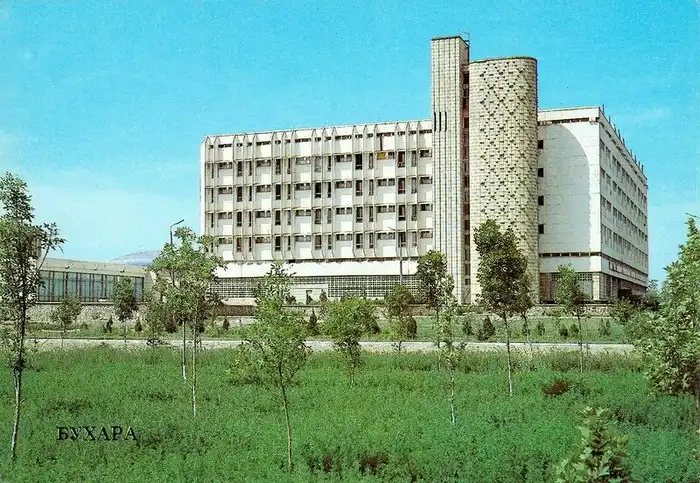
During the Soviet era, Bukhara underwent a massive transformation, balancing ideological modernization and industrial expansion against its ancient Islamic heritage. The era left behind a distinct architectural hybrid and a reshaped social fabric. Post-WWII architecture, particularly from the 1960s to 1980s, introduced monumental reinforced concrete structures. Architects integrated local Islamic design elements like panjara (geometric concrete sunscreens/lattice) and majolica tile work to adapt raw Soviet modernism to the desert climate. Soviet planners left much of the historic inner city (Shahristan) structurally intact, building wide boulevards, administrative plazas, and standardized residential micro districts (microrayons) outside the old city walls & public space.
Day-by-day itinerary
Day 1: Bukhara, Uzbekistan
1. Sadriddin Ayniy theatre was founded in 1921 by Fayzulla Khojaev who was the head of Bukhara People’s Soviet Republic (1920-1924) and at that time called as Bukhara theatre. First director of the theatre was Mannon Uyghur – a famous Soviet actor, playwright and director. In 1958, the theatre was officially named after the renowned writer and public figure Sadriddin Ayni. The formal establishment of the Uzbek SSR was proclaimed in Bukhara on the 27th of October, 1924. During the First All-Uzbek Congress of Soviets held in Bukhara in February 1925, delegates officially passed the declaration establishing the Uzbek Soviet Socialist Republic in this building. 2. Shukhov water tower designed by the famous Soviet engineer and inventor Vladimir Shukhov, the tower is built using his patented metal hyperboloid lattice design. Its lightweight, openwork steel structure allowed for maximum strength and wind resistance while using minimal steel. Built between 1927 and 1929, it originally functioned as a municipal water tower as part of Bukhara's first centralized water supply system. In 1975, a fire destroyed the tower's top wooden cladding and damaged the water tank. It ceased functioning as a water utility after the incident and sat unused for several decades. Reopened following extensive restoration efforts, the landmark has been repurposed into a popular tourist site and observation platform: Features an elevator leading to a top-tier viewpoint offering panoramic vistas over Bukhara's historical center and the nearby Ark. And also houses small dining facilities, a cafe, and a tourist information center at its base. 3. Bukhara State University was established in 1930 as the Bukhara Pedagogical Institute to train secondary school teachers across the region. Over the decades, the institution expanded its academic scope and was officially reorganized into a full state university in March 1992 following Uzbekistan's independence. When the institution was founded as the Bukhara Higher Pedagogical Institute, it originally operated out of the historic Russian-Chinese Bank building in old Bukhara. The building later served as a secondary school (School No. 6) as the university expanded. Today, Bukhara State University's main administration and core faculties are situated on a modern campus located on Muhammad Iqbol Street. It was built in 1935. 3. Fayzulla Khojaev house-museum is a historical house-museum in the Goziyon quarter of old Bukhara. It is dedicated to the life and career of Fayzulla Khojaev (1896–1938), a prominent Bukharian Jadid reformer, Chairman of the Council of People's Conciliators of the Bukhar People's Soviet Republic, and the first head of government (Chairman of the Council of People's Commissars) of the Uzbek SSR. The museum is located inside Khojaev's family home, a 19th-century estate constructed by his father, Ubaydullakhoja, a wealthy merchant trading in silk, Karakul sheep pelts and cotton. The house is a premier example of late-19th-century traditional Bukharian residential architecture, featuring separate public (havli berun) and private (havli durun) quarters, intricate wood carvings, painted plasterwork (ganch), and traditional climate-adapted courtyards. The museum displays traditional 19th-century Uzbek home furnishings, weaponry, ceramics, household items, and high-end silk garments (gold embroidery and ikat robes). It documents the Jadid movement in Bukhara, the overthrow of the Emirate of Bukhara in 1920, the foundation of the Uzbek SSR, and Khojaev's political career until he fell victim to Stalinist purges in 1938 (he was executed after the "Trial of the Twenty-One" and later rehabilitated in 1965). 4. Intourist hotel in Bukhara is actually the predecessor to the modern Grand Bukhara Hotel. During the Soviet era, "Intourist" was the state-run travel agency handling foreign tourism, and standard standardized hotels were built under this banner in major tourist hubs across the Soviet Union. The large multi-story high-rise originally operated as Bukhara's premier Intourist hotel before being rebranded and updated as the Grand Bukhara Hotel. Lunch at a local restaurant “Chinor” which opened during 1980s. 5. School #21 by the name of A.Pushkin was built in 1970 and still called as a Russian school & Soviet-era Mosaics of Bukhara. 6. Bukhara State Technical University (formerly known as the Bukhara Engineering and Technological Institute) is one of the premier technical higher education institutions in the Bukhara Region of Uzbekistan. It was founded in 1959 as a branch of the Tashkent Polytechnic Institute, later reorganizing into an independent institute, and officially reorganized into Bukhara State Technical University following recent higher education reforms. Oil & Gas Engineering: Chemical technology of oil and gas processing, extraction, and petrochemical production. Light & Textile Industry: Cotton processing, leather and fur tech, textile design, and apparel manufacturing. Food & Chemical Technologies: Food processing, inorganic chemistry, and food safety standards. Energy & Automation: Power engineering, energy efficiency, and modern industrial automation control systems. Architecture & Civil Engineering: Structural engineering, building design, and industrial transport systems. 7. The Soviet industrial zone in Bukhara developed primarily between the 1930s and the 1970s–80s as part of the Soviet Union's state-driven industrialization strategy for Central Asia. Because the central historic quarter of Bukhara was preserved as an architectural core, modern industrial facilities were established on the outer perimeters of the city—principally in the eastern, southern, and north-western industrial belts.
What's included
A professional English-speaking guide-driver; A bottle of water for each person.
Entrance fee; Lunch.
What to know
This tour can be customized. Please get in touch with me.
Route & locations
Bukhara, Uzbekistan