Tashkent-Bukhara-Samarkand-Tashkent 4days
About this tour
A trip to Bukhara and Samarkand will be an unforgettable journey where you will plunge into the depths of the history and centuries of Central Asia, unforgettable old streets and narrow streets of Bukhara, will return you the ancient times of the East, and the blue domes of Samarkand will reveal to you the greatness of the ancient civilization of Central Asia!
Day-by-day itinerary
Day 1: Tashkent International Airport, Тоshkent, Uzbekistan to Tashkent, Uzbekistan
Arrival in Tashkent, meet with driver and transfer to the Hotel from International Airport. Meet with guide at the lobby in the Hotel and start excursion in the capital of Uzbekistan: Khast Imam - cultic architectural complex and the religious heart of Tashkent, is located in the old part of the city. Here you will visit Barak Khan madrasah was built in the 16th century, Kaffal Shashi mausoleum was built in the 16th century, The Namazgah mosque built in 1965, Muyi Muborak madrasah was built in the 16th century. Currently, the madrasah houses the library of the Administration of the Muslims of Uzbekistan, which contains rare manuscripts and the Koran of Caliph Osman (7th century) – the world’s oldest manuscript consisting of 353 unusually large parchments with the earliest version of the Koran. State Museum of Applied Arts in Tashkent (1937) showcases Uzbekistan’s traditional crafts in a 19th-century Uzbek-European mansion. Exhibits include ceramics, textiles, suzanis, carpets, jewelry, and woodwork from Bukhara, Samarkand, and Khiva, highlighting 19th–20th-century artistry. A cultural gem preserving regional heritage. Chorsu Bazaar - City’s farmers market under a huge cupola that sells spices, grain, dairy products, fruits of the season. Here you can encounter the hustle and bustle of everyday life in Central Asia and you will have a good chance to see people in the colourful local dress. Independence Square - former “Red Squire” the main squire of the Tashkent with the monument to victims of the WW II. One night in Tashkent
Day 2: Tashkent, Uzbekistan to Bukhara, Uzbekistan
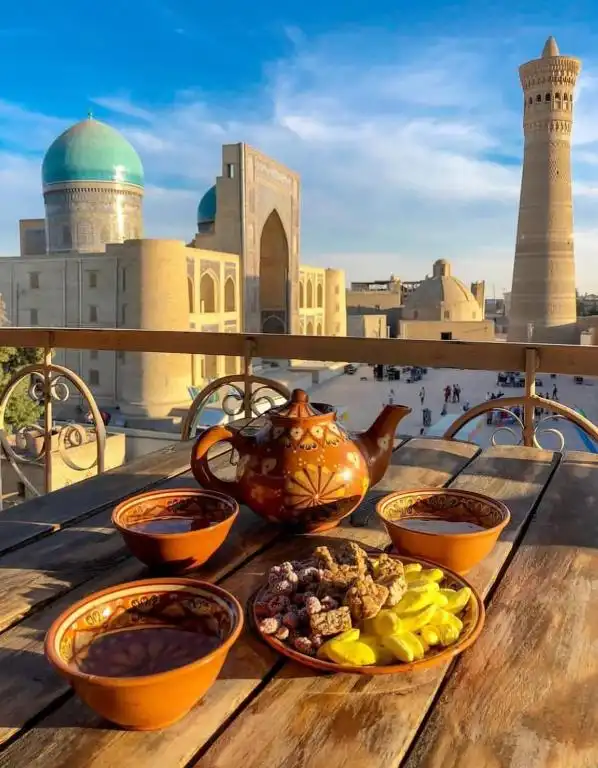
After Early Breakfast at hotel transfer to the train station and departure to Bukhara by speed train "Afrosiab", after arriving to Bukhara transfer to the Hotel. After rest meet with guide, start excursion: Ark Fortress - From the most ancient times the Ark was the fortified residence of the rulers of Bukhara. Everything could be found there - palaces, temples, barracks, offices, the mint, warehouses, workshops, stables, an arsenal, and even a prison. Poi Kalon - consists of three structures, Minorai Kalon, Masjidi Kalon & Miri Arab Madrassa. Minaret was built by the Karakhanid ruler Arslan Khan in 1127. The mosque was built circa 1514 & madrassah was completed in 1536. Trading Domes - consists of three trading centers: Tok-i-Zargaron (1570) – Jeweler’s Bazaar, Tok-i-Tilpak Furushon – Cap Maker’s Bazaar, Tok-i-Sarrafon – Moneychanger’s Bazaar. Lyabi Hauz - considered to be the center of the Old City. It means “ensemble near the pool”. The main element of this ensemble is the pool. The ensemble Labi-havz has three monumental structures. These are: Kukeldash madrassah (16th century) built by Abdullah II was, at the time, the biggest Islamic School in Central Asia. Nadir Devanbegi Madrassah (16th century) was intended to be a caravan saray, but according to the order of the ruler Imam Kulimkhan, was reconstructed into a Madrassah. Nadir Devanbegi Khanaka (winter mosque) was built at the same time as the Labi-havz (16th century). O/n in Bukhara
Day 3: Bukhara, Uzbekistan to Samarkand, Uzbekistan
Breakfast at hotel and continuation of an interesting excursion with guide: Sitorai-Mokhi-Khosa - also known as the "Palace Like the Stars and the Moon," is a country residence of the Emir of Bukhara, built in the late 19th to early 20th century. Currently, it houses a museum of decorative and applied arts. Nagshbandi - The Memorial Complex of Khoja Bakhouddin Naqshbandi is one of the most important Muslim shrines. Every self-respecting Muslim knows and reveres this name. The great theologian of the XIV century, founder of the Sufi Order "Naqshbandia" was buried 12 km from Bukhara in his native village of Kasri Orifon. Some time ago there was the pagan temple of the site of current tomb of Naqshbandi. After excursion transfer to the train station and departure to Samarkand by speed train "Afrosiab". Arrival in Samarkand and transfer to the hotel, free time and have a rest. O/n in Samarkand
Day 4: Samarkand, Uzbekistan to Tashkent International Airport, Тоshkent, Uzbekistan
Breakfast at hotel Meet with guide at the Hotel, start excursion: Gur Emir - as a conqueror there are few that are Tamerlane’s equal, both in territory and legacy left. Today one can visit his tomb in the beautifully reconstructed Gur-Emir Mausoleum (1404-1405, 15-17 centuries) and reflect on his life while looking at the largest piece of jade (greenstone) in the world. Bibi Khanum Mausoleum - named after the wife of Temur and built between 1399-1404 – is one of best-known architectural attractions of Central Asia. Registan Square – Registan became the city square when the life in Afrosiab stopped. Since that time Registan was reconstructed several times. Today it is surrounded by the three medreses Ulugbek, Sherdor and Tillokori. Shakhi Zinda - (9 -14, 19 centuries) situated on southeastern mound of Afrosiab. This architectural complex consists of 44 tombs in more than 20 mausoleums. Transfer to the train station and departure to Tashkent by speed train “Afrosiab” Arrival in Tashkent and transfer to the International Airport
What's included
1. Accommodation in 3* star hotels 2. Meals: B&B – 3 breakfasts 3. Services of local guides at the visits 4. Train tickets Tashketn-Bukhara, Bukhara-Samarkand, Samarkand-Tashkent 5. A/C transportation throughout the trip
1. Insurance 2. International flights 3. Entrance tickets to the sites indicated in the program 4. Uzbek visa 5. Meals: lunches and dinners 7. Personal expenses, including on-site photo and video rights 8. Excess baggage 9. Recommended tips for guides and drivers
What to know
This tour can be customized. Please get in touch with me.
Route & locations
Tashkent International Airport, Тоshkent, Uzbekistan to Tashkent, Uzbekistan