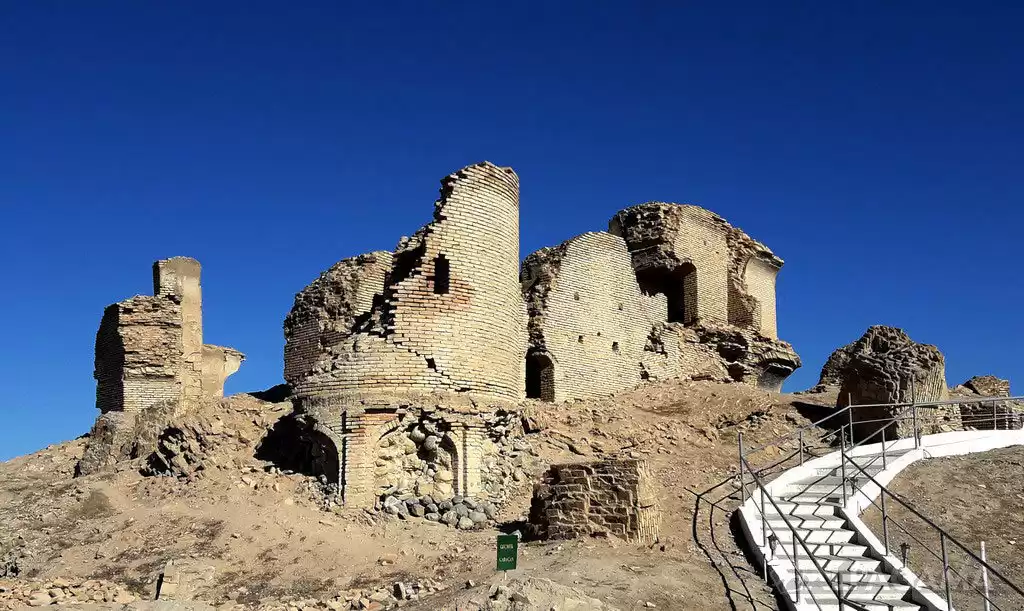
Tour Of The Ancient Mausoleums Of Turkmenistan
About this tour
On this tour you can explore historical areas of Turkmenistan. You can see our historical ancient mausoleums, old holy places full of local legends, an ancient settlements and etc.
Day-by-day itinerary
Day 1: Ashgabat, Turkmenistan
Meeting travelers at the Ashgabat airport. Transfer to the hotel. A tour round the capital to icon places of the area of independence, such as Monument of Independence in a picturesque park, a fountain-monument of ten Akhal-Teke horses devoted to the 10th anniversary of independence and an impressive Ertoghrul Ghazi mosque which is one of the most beautiful Muslim mosques of Turkmenistan. Lunch in Ashgabat. In the second half of the day a drive to the mosque in the village of Gypjak about 7 kilometers west to the center of Ashgabat. It was built in 2004 and by the first President of Turkmenistan. He was buried in its Mausoleum on December 24, 2006. Continue with Gokdepe mosque. Turkmen fortress in 45km to the northwest of Ashgabat, built in 1879 by the population of Ahal-Teke oasis before the attack of the Russian army. Return to Ashgabat. Dinner at a local restaurant.
Day 2: Ashgabat, Turkmenistan to Ak Ishan, Bozogoli, Turkmenistan
Early breakfast at the hotel. A 1,5 – 2 hours drive to the west of Turkmenistan to visit an Ak Ishan Pilgrimage place. Ak Ishan became a legendary person, and nowadays is a highly honored person for Turkmen people. He was a well-educated and famous scientist and a noble person. He was born in a poor nomadic family in 1788 in a village of Bokurdak. His father was a shepherd. His name at birth was Akmammet. When Akmammet (Ak Ishan) was 7 years old, he learned to read and write in Arabic. By the time he was 12 years old people started to talk that he already learnt Koran. Later his father sends him to study to Khiva. He moved there with his family, and there he became famous for the first time. When he finished his education, he arrived to Baharden (Archman), and continued to serve to local people as molla. The king of Khiva sent his servant to bring back Ak Ishan to Khiva. Finally, he accepted wish of King, and in 1850-1851 Ak Ishan becomes an advisor of King of Khiva. But Akmammet (Ak Ishan) never felt himself to be the king’s advisor; he felt he was a God’s man. Later he returned back to Akhal. Ak Ishan died in 1878 at the age of 90 and was buried at the cemetery in Archman. His grave is highly respected and honored even today. Return to Ashgabat and have a dinner at the restaurant.
Day 3: Ashgabat, Turkmenistan to Dashoguz, Turkmenistan
Early breakfast at the hotel, morning flight to Dashoguz. Drive to Kunya-Urgench about 100 km to explore historical area. KyrkMolla hill is located in Kunya-Urgench to the northeast of the city near the Sultan Tekesh Mausoleum. This place is the ancient center of Gurganj. The excavations revealed a vallum of the ancient period and an altar. Mausoleum of Turabek-Khanum indeed became the most magnificent structure in the entire country. Amazing in its beauty and grace, it is the structure with the richest interior and exterior finish, with surprisingly open and light hexagonal hall with the area of about a hundred square meters, decorated with carved mosaic. It was crowned with a huge dome. It was, probably the most perfect dome in the entire Central Asian Turan. Mausoleum of Nadzhimetdin Kubra is the founder of the dervish order "Kubraviya" in Islam, a Sufi sheikh - the main monument in the memorial complex "360". This place is considered holy. Pilgrims from all world pay visits there. According to the legend, Horesmshakh Mohammed II executed one of the best Kubra's students after by a false denunciation. The holy man got angry and cursed Khoresm. Following the curse the mighty state fell under aggressive Mongol invasion. Kubra himself and his 360 students fought side by side to protect their city. This battle was the last heroic deed of Nadzhimetdin for the glory Islam: a Mongolian warrior beheaded the holy man. The cemetery where today the Mausoleum of Nadzhimetdin Kubra and the mausoleums of Sultan Ali and Piryarvali stand, was built on the site of the battle. Right beside them is the grave of young Dzhamildzhan, Nadzhimetdin Kubra's favorite student. Mausoleum of Nadzhimetdin Kubra includes 4-dome premises: the lobby, two assembly rooms and gurkhanu - a hall in the center of which a beautiful gravestone used to stand right on the spot where the body of the holy man fell with a high obelisk marking the place where his head cut by a Mongolian sword dropped. Unfortunately, when the dome fell down, about fifty years ago, these obelisks were heavily damaged and are waiting for restoration. Return flight to Ashgabat. Dinner at the restaurant.
Day 4: Ashgabat, Turkmenistan to Mary, Turkmenistan
After the early breakfast you will move to the East of Turkmenistan, the group will go by bus to Mary. Visit Old Merv – Merv was located at the road crossing of the Great Silk Road and quickly became one of the largest and biggest cities of the ancient world. Guided tour: Gyz Gala, Erk Gala, Soltan Gala, SoltanSanjar Mausoleum, Ibn Zeid Mausoleum. Lunch at the local restaurant. Continue with the 5th center of civilization - Ancient country of Margush in the Karakum desert. Then continue to city Mary. Dinner at the restaurant. Accommodation at the hotel.
Day 5: Mary, Turkmenistan to Ashgabat, Turkmenistan
After the early breakfast departure to Ashgabat visiting on the way an ancient settlement Abiverd - one of eight historical reserves of Turkmenistan comparable to Kunya-Urgench, Nissa, Merv, Dakhistan. The ruins of Abiverd are located between Ashgabat and Mary. Lunch at the local restaurant. Continue with the architectural monument of the 11th century -the mausoleum of Abu Said ibn Abi’l-Khairnamed Mane Baba. The monument is a unique medieval architecture. Visiting the ancient settlement Anew. Two large mounds, 300m apart, are not hugely exciting to look at, but have proved greatly significant in uncovering information about early agricultural settlement in Turkmenistan. The major sight remaining for the visitor today is that of the ruins of the 15th century Seyit Jamal-ad-Din Mosque. The mosque was built in 1456 through the finance of one Mohammed Khudaiot, the representative of the Timurid governor of Khorasan, who chose to site the building at the grave of his father, Sheikh Jamal-ad-Din. The mosque, which is in the southern part of the old fortress of Bagabad, included an extensive religious complex with a madrasa and accommodation for pilgrims. Reach Ashgabat city, accommodation at the hotel. Dinner at the restaurant.
Day 6: Ashgabat, Turkmenistan to Ashgabat International Airport, Ashgabat, Turkmenistan
Breakfast at the hotel. Check-out and transfer to Ashgabat Airport.
What's included
* Tour package (LOI, Register fee., permit fee) * Hotel stay (5 nights) * Guide (6 days) * Transport (6 days) * Flight Ashgabat-Dashoguz-Ashgabat * Meal (FB) during the all route * Transfers during the all route * Entry tickets (Kone-Urgench, Margush, Ancient Merv, Museums) * Daily1.5 lt water
* Visa fee * Migration tax (12$) *Extra meal, services, Folklore concerts and show *Private expenses, gratuities *Insurance *Fee for using cameras on monuments Note:Each Traveler should have 2 photos (5x6) to be presented at the points of entry.
What to know
This tour can be customized. Please get in touch with me.
Route & locations
Ashgabat, Turkmenistan