Tashkent-bukhara-samarkand-tashkent - 3 Day Adventure
About this tour
TASHKENT - BUKHARA - SAMARKAND - TASHKENT
Samarkand and Bukhara—two iconic Silk Road cities where history was shaped. Tashkent is a both historic and modern city, and it is surely one of the best choices to come as a tourist
Samarkand, the heart of the Timurid Empire, showcases the legacy of Tamerlane and the breathtaking architecture of the Registan, where scholars once gathered. Bukhara, with its ancient Ark Fortress and tranquil Lyab-i-Hauz, served as a spiritual and intellectual center for centuries. Strolling through its streets feels like stepping back in time, to an era when the city attracted traders and explorers from around the world.
This 3-day tour is not just about sightseeing—it’s about immersing yourself in the living history of Uzbekistan’s most legendary cities!
Day-by-day itinerary
Day 1: Tashkent, Uzbekistan to Bukhara, Uzbekistan
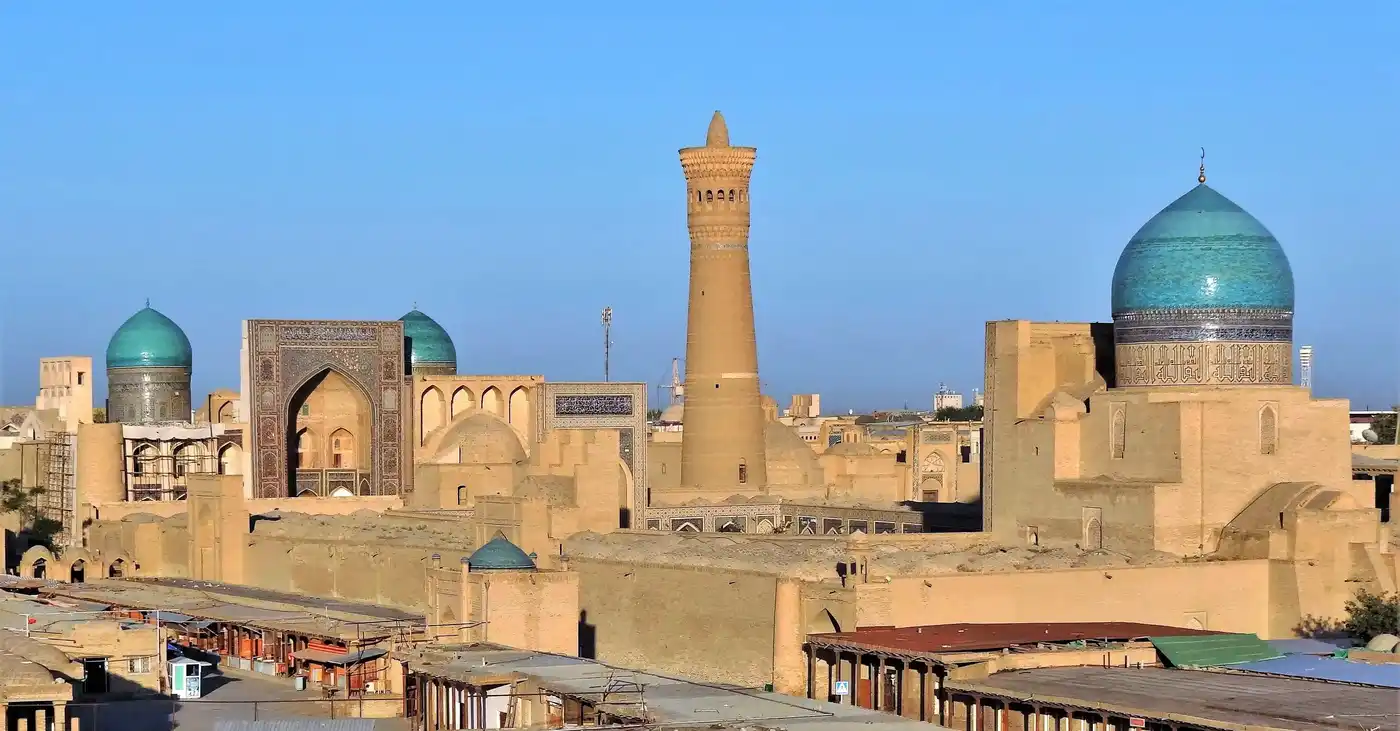
As ancient as Samarkand, Bukhara is ancient Uzbek city through which the Great Silk Road ran. In the Middle Ages, Bukhara was a major center of Islamic theology and culture. To this day, there are hundreds of well-preserved buildings (mosques, madrasahs, bazaars and caravanserais) erected in the period from the 9th to the 17th centuries. Take high speed train Tashkent-Bukhara (subject to availability: 4 hours). Pick up at Bukhara Railway station, drive to Hotel, check-in, meet your guide & start tour: Poi Kalyan Mosque - The Kalyan Minaret is the last surviving fragment of the Kara-khanid era mosque built by Mohammad Arslan Khan in 1127, predating the Mongol conquests. Standing tall at 45.6 meters, this unlikely survivor of the city's early days — which impressed Genghis Khan so much that he refused to order its destruction — continues to serve as the centerpiece of the city at the Po-i-Kalyan square. Ark of Bukhara - The Ark, a royal town-within-a-town, is Bukhara’s oldest structure, it was home to the rulers of Bukhara for over a millennium. The Ark is as old as Bukhara itself. The founding of the original fortress is blurred in antiquity, but it was certainly the focus around which developed the medieval town. Bolo Hauz Mosque – The Bolo Hauz Mosque stands opposite the Ark Fortress in a Kosh arrangement with the resistance between them. Its name means "above the pool", referring to the octagonal hauz, or artificial pond, located directly in front of it. Begun in 1712, early in the reign of Abu'l-Faiz Khan (r. 1711-47), it is one of the last and finest of Bukhara's major buildings prior to the modern era. Maghoki Attori Mosque - Oldest Mosque in Central Asia that once served as a Buddas and Zoroastrian temple. Here you can see amazing brickwork and architecture. Before the construction of the first synagogue, historical accounts tell of Jews either worshipping alongside Muslims, or in other cases after the Muslims in mosques. Masjid-e Maghaki-ye Attari translates from Persian as the mosque in a pit in the perfume market, as before the Arab conquest, there was a perfume bazaar on the site of this mosque. Trading Domes - Bazar filled with artisanal workshops that has existed since the middle ages. Lyab-i-Hauz - Built in the 16th - 17th centuries, Lyab-i Hauz Ensemble, including Nodir Divan Begi Madrasah, Khanaqa, the water reservoir & Carvan Saray to this day remains one of the major squares in Bukhara. Lyab-i Hauz Ensemble is probably the most popular Bukhara tourist attraction, often used as a rest stop, thanks to its grandness, tranquility and old age. Meals not included Accommodation included: Overnight in centrally located highly rated 3-4 star or boutique hotel
Day 2: Bukhara, Uzbekistan to Samarkand, Uzbekistan
One of the oldest continuously inhabited cities in Central Asia, Samarkand is older than its recorded history. From being the center of Sogdian Civilization to the birthplace of the Timurid Renaissance, this city has seen history being shaped, empires rise and fall. Today, Samarkand is the second biggest city in Uzbekistan after Tashkent. Registan Ensemble - heart of the ancient city of Samarkand of the Timurid Empire, meaning sandy palace or desert in Persian. It was a public square where people gathered to hear royal proclamations announced through enormous copper pipes called dzharchis. It was also a place where public executions took place. It is framed by three madrasas, namely Ulugbek (1417-1420) Tilla Kari (1646-1660) and Sher Dor (1619-1636) (left to right) of distinctive Islamic architecture. The square is regarded as the hub of Timurid renaissance. Gur Emir Mausoleum - As a conqueror there are few that can be considered Tamerlane’s equals, both in territory conquered and legacy left. Today one can visit his tomb in the beautifully reconstructed Gur-Emir Mausoleum (1404-1405, 15-17 centuries) and reflect on his life while looking at the largest piece of jade (greenstone) in the world. Shah-i-Zinda - Shakhi-Zinda Ensemble – (IX) situated on southeastern mound of Afrosiab. This architectural complex consists of 44 tombs in more than 20 mausoleums. The greatest significance of Shah E Zinda is that he was the First cousin of the Prophet Muhammad and resembles the Prophet the most. Bibi Khanym Mosque - in 15th century, it was considered as one of the most magnificent mosques in the Islamic world. It is considered as a masterpiece of Timurid renaissance. Construction began shortly after Timur’s Indian campaign which took place in 1399 Siab Bazaar - Siab Bazaar in Samarkand is still as impressive as it was many years ago. Its abundant produce and handicrafts is evidence of the natural wealth of Uzbekistan and its people’s talents and diligence. Siab Bazaar - A Bazaar in Samarkand is still as impressive as it was many years ago. Its abundant produce and handicrafts is evidence of the natural wealth of Uzbekistan and its people’s talents and diligence. Shah-i-Zinda – meaning The Living King in Persian, it is a necropolis in Samarkand. The ensemble includes mausoleums and other ritual buildings of 11th through 15th and 19th centuries. The name is connected with the legend of Qutham ibn Abbas, a prophet of Prophet Muhammad who is said to be buried there. The complex was formed over eight centuries and now comprises more than twenty buildings. Ulugbeg Observatory - Ulugbek's Observatory – observatory of Timur's grandson. Only the foundations remain but it is truly extraordinary. Ulugbek was an astronomer, scientist and architect. His scientific and astronomical discoveries greatly advanced knowledge in these fields. The only thing that was preserved is a part of huge sextant – major astronomic instrument, the lowest part of which was in a deep trench (11km). Meals included: breakfast Accommodation not included
Day 3: Samarkand, Uzbekistan to Tashkent, Uzbekistan
The capital of Uzbekistan, Tashkent, is known both for its ancient status on the Silk Road (Al Shash) and for the mix of modern and soviet era architecture. The city is over 2,200 years old and has been the subject of countless conquests that defined history. Amir Temur Square - Central to the modern city, Amir Timur Square is a lush, green space with plenty of flowers and fountains. In the center of the square you will find a statue of the Great Amir Timur on horseback. Alisher Navoiy Theater Designed by Alexey Shchusev, the building of the theater was built between 1942-1947 and was opened to the public, celebrating the 500th anniversary of the birth of Alisher Navoi. The tour of this facility is conducted outside the building. State Museum of History of Uzbekistan - The State Museum of History of Uzbekistan, previously known as the National Museum of Turkestan, was founded in 1876 and is one of the oldest museums in Central Asia. Rich museum exhibits give insight into the history of civilization of the great Silk Road. or Alternatively - Tashkent Applied Arts Museum Independence Square (Mustakillik Square) - A former red square and a walking area surrounded by the Anhor river, fountains and endless trees. Monument of Courage Earthquake Memorial - Beautiful Monument commemorating the biggest earthquake in central Asia, with its epicenter in Tashkent which destroyed much of the city. Ensemble Hazrati Imam - One of the spiritual monuments of Tashkent is the Khazrati-Imam ensemble, popularly called Khast-Imam. The square is located in the heart of the old city. The complex consists of Tillya Sheikh Mosque, Abu Bakr Kaffal Shashi Mausoleum, Barak Khan madrasah and Imam al-Bukhari Islamic Institute. Tashkent Metro - The Tashkent metro was the first underground in Central Asia. It was completed and opened in 1977. All stations have their own unique architectural appearance: marble, granite, rows of columns, colorful bas-reliefs, etc Chorsu Bazaar - City’s farmers market under a huge cupola that sells spices, grain, dairy products, fruits of the season. Here you can encounter the hustle and bustle of everyday life in Central Asia and you will have a good chance to see people in the colourful local dress.
What's included
What to know
This tour can be customized. Please get in touch with me.
Route & locations
Tashkent, Uzbekistan to Bukhara, Uzbekistan