1. Why Iran
Iran in the heart of the Silk Road is one of the world’s most treasured travel destinations, blessed with extraordinary historical sites, fascinating culture and exquisite landscapes with snow-capped mountains, rich forests and hot deserts, boasts to be a destination for all seasons.
Rich Persian heritage dating back to 3,000 years is evident throughout the country with abundant ancient sites. It offers the traveller so much variety in culture and cuisine. From traditional nomads of Qashgaei, Bakhtiari and Shahsevan, proud Turkmen, hospitable Gilaki, friendly Azeri, colourful Kurds to modern Tehrani.
1.1. Iran’s climate
It is possible to bike Iran in any
season, you only need to choose when and which routes to go. Due to the vastness of the country and is well extended in both east-west and north-south coordinates Iran has the unique potentiality of a varied climate that
provides travellers with the all year round opportunity of travel in both high and
low seasons. There is a considerable difference in climate from region to region. Central Iran is quite
dry and desert-like, the northwest is mountainous, the north is subtropically covered with thick forests, and the
south is semiarid and tropical.
Spring
and autumn give you the best weather across the whole country to avoid extremes
in temperature. The best time to cycle in central and southern Iran is from
November to April. January and February are suitable to explore the Islands in
the Persian Gulf. During the summer the cool mountain regions in the northwest will
make for the most pleasant cycling.
1.2. Persian hospitality
The
Iranian culture of legendary hospitality roots in an old belief that “guest is
God’s friend”. This justifies the numerous stories told by tourists about the
unrivalled Persian trait, who consider the people the true highlight of Iran
holidays, or think that their understanding of the hospitality is brought to
new heights.
Iranian
consider tourists to be honoured guests and want their guests to feel welcomed, so
they shower them with hospitality. They will always approach to see if you need
anything. If you pull out a map someone is there to help you. If you ask for
directions, they will probably walk you to your destination. Generally, Iranians are caring and feel responsible for being by
your side. Locals will pull over to offer you food and drinks, invite you to
their home to share a meal and even spend the night. They may send you off with goodies to keep you fuelled during your
next leg of cycling. Iranian villagers and nomads are very welcoming and might
farewell you with a pot of their own produced diary or bread. Even the taxi
drivers, shopkeepers and restaurant owners will refuse payment.
Lonely Planet
called Iran the most rewarding destination on Earth because of this Iranian
hospitality. It is so renowned that put Iran on the top destinations of 2017
list.
2. Popular cycling routes in Iran
Iran
is a vast country with four distinct seasons. This means you have a wide range
of choice when and which routes to cycle. You can combine biking, historical
exploration and immersion in the local culture each route you take:
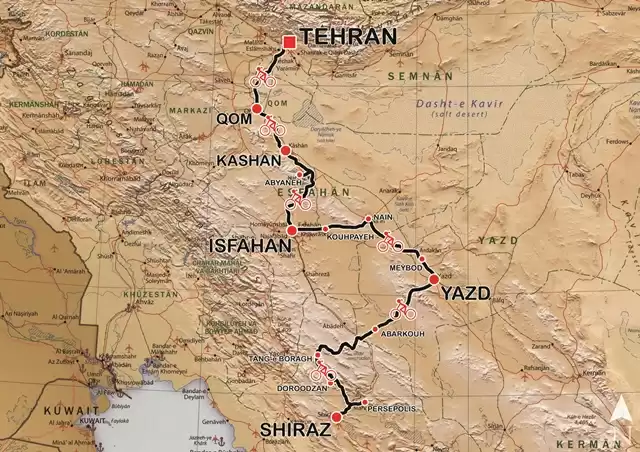
On the classic route:
Tehran, Kashan, Isfahan, Shiraz, and Yazd. This also mainly accords with the
ancient Silk road for you to trace the magnificent legacies of the Persian
Empires. November to April is the most favorable weather
for this route.
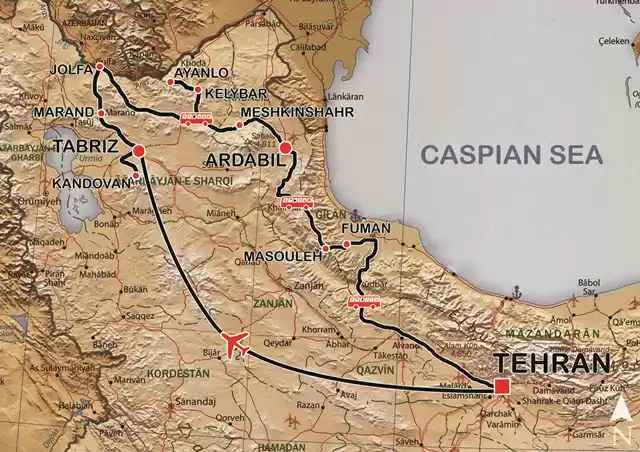
Caspian Sea shores and north forests to northwest: You’ll come across a mix of both nature and culture as you explore
the forests, the sea, and Alborz Mountains as well as small, rural villages and
local traditions of the diverse provinces in north and northwest Iran. Jangle-e Abr, or Cloud Forest is usually bathed in an ocean of
clouds and Gisoom jungle is one of the most beautiful and peaceful forests in
Iran. Tabriz is the door to Iran for cyclists heading to or from Turkey.
Northwest in summer is quite delightful when it is hot in the rest of the
country.
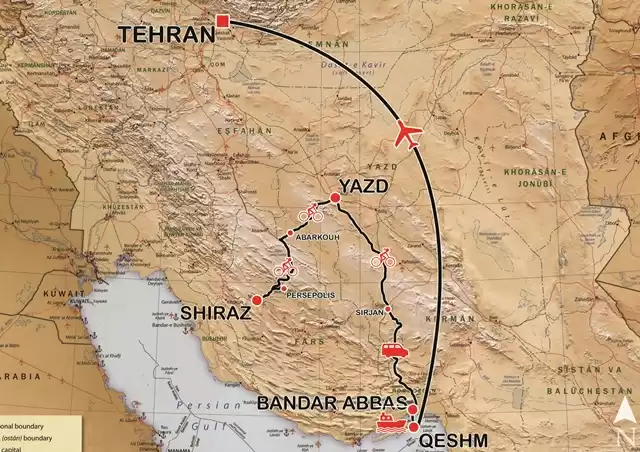
Along the Persian Gulf coast, or the islands; Qeshm , Kish and Hormoz
Kish
has the longest and completely distinct bike-riding paths. Rentals are
available. Qeshm is the largest island in the Persian Gulf. While cycling, you
will cross numerous wonderful attractions such as mangrove forests, Valley of
the Stars, the Salt Cave, and Hara Forest as well as many scenic beaches.
Visit Rainbow Mountains and the Portuguese Castle in Hormuz. Winter is the best
time to this tropical arena.
Alborz Mountain: there are many
areas for all types of mountain biking, especially popular with professional
cyclists. The terrain offers routes combined of asphalt, dirt, downhill and single
track. A couple of hours northeast of Tehran, Lar
National Park is located in the area home to mount Damavand.
Zagros Mountains: extended
from west to southwest, it has impressive sceneries to offer. You will pass
through fascinating landscapes of Oak forests in the region. Because of the
steep slopes and rough terrain of this part, it is a good destination for
professional cyclists. You can start at Uraman Takht, a village built into the
cliffside, and go south toward the Khuzestan province.
Central deserts of Lut, Dasht-e Kavir and Maranjab: Maranjab is fairly close to Tehran. The Salt Lake and Wandering
Island has made the desert one of the most popular destinations for
adventurers. Sense the magic of desert sand dunes and spend the night at the
17th century caravanserai of Maranjab. Mid-autumn to mid-spring is fine with
the deserts.
3. Female cyclists
Women
are required to wear Islamic hijab in public, this means a headscarf, a
mid-thigh tunic and an ankle length pants. Ensure your hair, arms and legs are
covered.
4. Accommodation
Iran
offers tourists a range of accommodation options, five-star hotels, boutique
hotels, hostels, homestays and caravansaries. For cycle tourists who like to
camp there aren’t many typical campsites with hot showers and kitchen
facilities in Iran. Instead, you will rely on wild camping between cities and towns.
This is never a problem as there are plenty of remote areas to pitch your tent.
Camping
near the police stations, petrol stations and Red Crescent Rescue Stations
found scattered along the main highways are of easy options in Iran. They are
usually happy for you to camp nearby and will give you access to their
bathrooms and water. You can also camp in city parks where there is usually a
guard on duty staying in a little house inside the park.
Reserving
accommodation through a travel agency will give you peace of mind and ensures
an appropriate, secure place with reasonable price.
5. Bike shops and equipment
Every
city has shops selling brands as well as cheaper Chinese parts, so high quality
bicycle parts are easy to find in Iran. Camping equipment like tents and
sleeping bags, and smaller items like camping gas cartridges and head torches
is also widespread.
6. Iran roads
Most
roads across the country are sealed with asphalt or bitumen. They are in good
shape with good surfacing and ridable shoulders on the bigger routes. Iran has
a comprehensive network of secondary roads, most of which are paved, so you can
find smaller alternatives to the main highways if you wish to avoid the traffic
and noise. In mountainous areas you may come across a few tunnels, most of
these are short and longer ones tend to be well lit. The signs are in English and Farsi.
Bikes on buses and trains: If you plan to cover a vast region, the distance makes you put your
bike on some form of public transport. It’s possible but you’ll pay extra and it
will depend on the length of the journey and class of the bus. If you want to
take a cargo bike on the train you need to be at the train station ahead of
time to check your bike as cargo.
Visa
Normally,
getting a visa takes around 7-10 working days and for nationalities as
American, British and Canadian, it will take 1-2 months. You can extend your
visa at least twice by its original duration, so an initial 30-day visa can
give you up to 90 days in Iran. You can do this in the main cities of Tehran,
Shiraz, Isfahan, Yazd and Tabriz. To save time connect to a travel agency to
provide you with the Iran Invitation Letter (Authorization Number). You can
either collect your visa in Iran, at the airport or in embassies available
around the world.
Multi-country cycling and border crossing
Iran
shares borders with Azerbaijan and Nakhchivan, Armenia, Turkey, Iraq, Pakistan,
Afghanistan and Turkmenistan. You can travel overland to/ from these neighboring countries. Getting onward
visa is possible in Tehran.
Borders’ opening hours (may be subject to change)
Iran – Turkey: Bazargan:
24/7, Sero: 24/7, Razi: 8 – 17.
Iran – Azerbaijan: Astara:
24/7, Bilasuvar: 24/7.
Iran _ Nakhchivan: Jolfa:
24/7, Poldasht : 8:30_ 00:30.
Iran – Armenia: Nordooz:
24/7.
Iran – Turkmenistan: Sarakhs: 7:30_ 16:30, Bajgiran: 7.30 – 17, Lotfabad: 7_ 17:30,
Incheboron: 7:30_ 17.
These
are the safe borders to cross, other borders less used include:
Iran – Iraq: Khosravi:
24/7, Chazabeh: 7_ 17 Soomar: 7_ 17.
Iraqi Kurdistan:
Bashmakh: 24/7.
Iran – Pakistan: Mirjaveh:
8_ 18:30, Rimdan: 8_ 15.
Iran – Afghanistan: Taybad:
7_ 17, Milak: 7_ 19.
Although
it is very easy to travel by yourself, in group or solo, across the country,
getting the support of a local travel agency is recommended for your
convenience with or without a tour guide. The point is that you are considered
to being invited by the agency, so their help especially in getting visa in
much shorter time and reserving accommodation according to your budget worth
noting. They also help you 24 hours a day 7 days a week about the information
you may need throughout the country.
It is possible to bike Iran in any season, you only need to choose when and which routes to go. Due to the vastness of the country and is well extended in both east-west and north- south coordinates Iran has the unique potentiality of a varied climate that provides the travellers with the all year round opportunity of travel in both high and low seasons. There is a considerable difference in climate from region to region. Central Iran is quite dry and desert-like, the northwest is mountainous, the north is subtropically covered with thick forests, and the south is semiarid and tropical.
VIEW PROFILE →