Wildlife Observation And Citizen Science In The Gobi
About this tour
Mongolia is a country with a very diverse but also fragile environment which has been tradionnally protected through environmental local practices and beliefs. Today, Mongolia's nature is challenged by climate change, mining activities and development of linear infrastructures, and increasing livestock size and overgrazing.
I am wildlife biologist and conservationist and I will lead these wildlife observation expeditions in the Gobi Desert, in the study area of my conservation NGO.
During these expeditions, you will gain a clear understanding about the eastern Gobi ecosystem and its wildlife and the challenges to protect this unique ecosystem and its wild species. You will have the privilege to visit an area which is so little visited in Mongolia.
Our NGO practices people-centred conservation and during this journey you will have a chance to : learn more about Gobi wildlife, meet local people such as protected areas' rangers, Buddhist monks, small market gardeners, and nomadic herders who are partners in conservation with our NGO. You will have the opportunity to discuss with them about their involvement in our conservation program and their actions and motivations towards the protection of the Gobi ecosystem.
Day-by-day itinerary
Day 1: Ulaanbaatar, Mongolia
Ulaanbaatar is home to roughly 45% of Mongolia’s population. During today's free city tour you will get a contrasting insight into a way of life, compared to that of the rural population as you will spend the day in the company of a local guide. Even though the city is striving to develop and improve it still can offers some amazing experience and discovery, especially in spring and summer. Accommodation: Your own choice Meals: Local lunch and welcome drink Travel: Free transfer
Day 2: Ulaanbaatar, Mongolia to Khustain Nuruu, Mongolia
Khustain Nuruu National Park is part of UNESCO’s ‘Man and the Biosphere’ reserves. The Khustain National Park Trust was established in 2003 and deals with the management of the national park contracting with Mongolia’s Ministry of Nature and Environment. Khustain is now run as a dedicated NGO specialising in nature and environmental research and conservation. As the Przewalski horse (known as takhi in Mongolian) is a flagship species, its protection also helps to increase environmental awareness in Mongolia, and as an umbrella species, its protection can help protect other species sharing the same habitat. Khustain Nuruu is now known as a conservation success story in the world, as since the reintroduction of the Przewalski's horse in Mongolia in 1992, its population in Khustain Nuruu keeps increasing year after year and the wild horses are well adapted to their new habitat. Once you will arrive in the park you will first visit the information center which is located at the entrance of the park. Then, we will travel more deep inside the park and we will trek a bit to observe there a variety of wildlife such as: red deer, corsac foxes, Siberian marmots, black vultures and other raptors and birds. If we are lucky we will be able to observe from distance the takhi but there is of course no guarantee as with all other wldlife that we will able to observe them. We will follow at all time the strict rules and regulations of the national park, and observation of wildlife will be only made from wildlife friendly distance and gettnig close won't be allowed today as during any other day of this trip as we don't want to disturb and have a negative impact on wildlife. Accommodation: Of your own choice in Ulaanbaatar Meals: Lunch Travel: Roughly 110km on asphalt and dirt road (approx 2 hours diving time ONE WAY not including stops).
Day 3: Ulaanbaatar, Mongolia to Ikh Nartiin Chuluu Nature Reserve, Ikhe Nartön Khid, Mongolia
Your destination is Ikh Nart – a wildlife region of rocky terrain and canyons. Located in Dornogobi Aimag, this reserve harbours a wide diversity of flora and fauna and is a long-term study site between Denver Zoo and the Mongolian Academy of Sciences. The studies aim to understand the ecology of the region, the behaviour of the resident species and to improve conservation management in the region. Three projects are on-going – the Argali Sheep / Siberian Ibex Project, the Carnivore Project and the Cinereous Vulture Project. Although small (66,000 hectares), Ikh Nart represents a strong-hold for the globally threatened Argali Sheep – the largest mountain sheep in the world. It is also one of the most significant breeding sites for the Cinereous Vulture (European Black Vulture). Accommodation: Tent Camp. UK VANGO tents. We also provide a kitchen tent and a toilet tent (well, a tent to cover the hole in the ground. I call it a ‘loo with a view!”). Solo travellers receive their own tent – no single supplement required. Meals: L/D and B/L/D Travel: Day Three – Roughly 320km on asphalt and dirt road (approx 7 hours diving time not including stops).
Day 4: Ikh Nartiin Chuluu Nature Reserve, Ikhe Nartön Khid, Mongolia
You will spend this day discovering the wildlife and biodiversity of the region together with your scientific guide and one of the local protected area ranger (depending on their availability). Accommodation: Tent Camp. UK VANGO tents. We also provide a kitchen tent and a toilet tent (well, a tent to cover the hole in the ground. I call it a ‘loo with a view!”). Solo travellers receive their own tent – no single supplement required. Meals: L/D and B/L/D Travel: Day Three – Roughly 320km on asphalt and dirt road (approx 7 hours diving time not including stops).
Day 5: Ikh Nartiin Chuluu Nature Reserve, Ikhe Nartön Khid, Mongolia to Khamariin Khiid Monastery, Hamariin Hural, Mongolia
Khamariin Khiid is a monastery that is considered an energy centre known as Shambala created around the cult of a Mongolian monk – Danzan Ravjaa. The monastery was destroyed during the 1930s political purges but has been reconstructed and is a major pilgrimage site for Mongolians. It also gives spectacular view points out over the Gobi. We include a visit because the monastery plays an important part in the history and culture of the Gobi. In addition, Buddhist monks are traditionally taught to love and protect wildlife and use their environment in an appropriate manner. Buddhist communities in Mongolia often work within the local community to help protect the local environment. Accommodation: Tent Camp. UK VANGO tents. We also provide a kitchen tent and a toilet tent (well, a tent to cover the hole in the ground. I call it a ‘loo with a view!”). Solo travellers receive their own tent – no single supplement required. Meals: B/L/D Travel: Roughly 10km on asphalt and dirt road (approx 7 hours diving time not including stops).
Day 6: Khamariin Khiid Monastery, Hamariin Hural, Mongolia to Sainshand, Mongolia
This is the start of six days spent in the Goviin Khulan research area. Examples of the activities that could be conducted in the research area are: -Observation of wildlife species including recording GPS positions for each species observed -Recording of the presence of each species observed including animal tracks, dung and scats. -Settlement of camera traps at strategic locations -Sampling of plants in specific areas -Record of carcasses found, -Meeting with rangers and families involved in the project -Cleaning of specific sites During the whole stay in our NGO's study area, strict rules regarding observation of wildlife, collection of samples and waste management will be followed in order to reduce as much as possible our impact on wildlife and their habitat. Getting close to wildlife to take photographs will be then prohibited. Accommodation: Day Six – Ten – Tent Camp. UK VANGO tents. We also provide a kitchen tent and a toilet tent (well, a tent to cover the hole in the ground. I call it a ‘loo with a view!”). Solo travellers receive their own tent – no single supplement required. It might be that at Native Mountain you can stay in simple shared accommodation provided by the monks but this is not guaranteed or confirmed. No showers apart from if en-route the local town shower house is open (your own private cubicle with plenty of hot water. Queue with the locals and enjoy experiencing a little of their daily way of life). Day Eleven – Provincial Hotel in Sainshand. The Khar Gobi Hotel is unexpected in the provincial dustiness of Sainshand. You’ll be surprised! Meals: B/L/D Travel: Driving will be between sites. Most days will be 4-5 hours driving time on dirt roads (not including stops) although some may be shorter or longer depending on the route and / or the activities.
Day 7: Sainshand, Mongolia
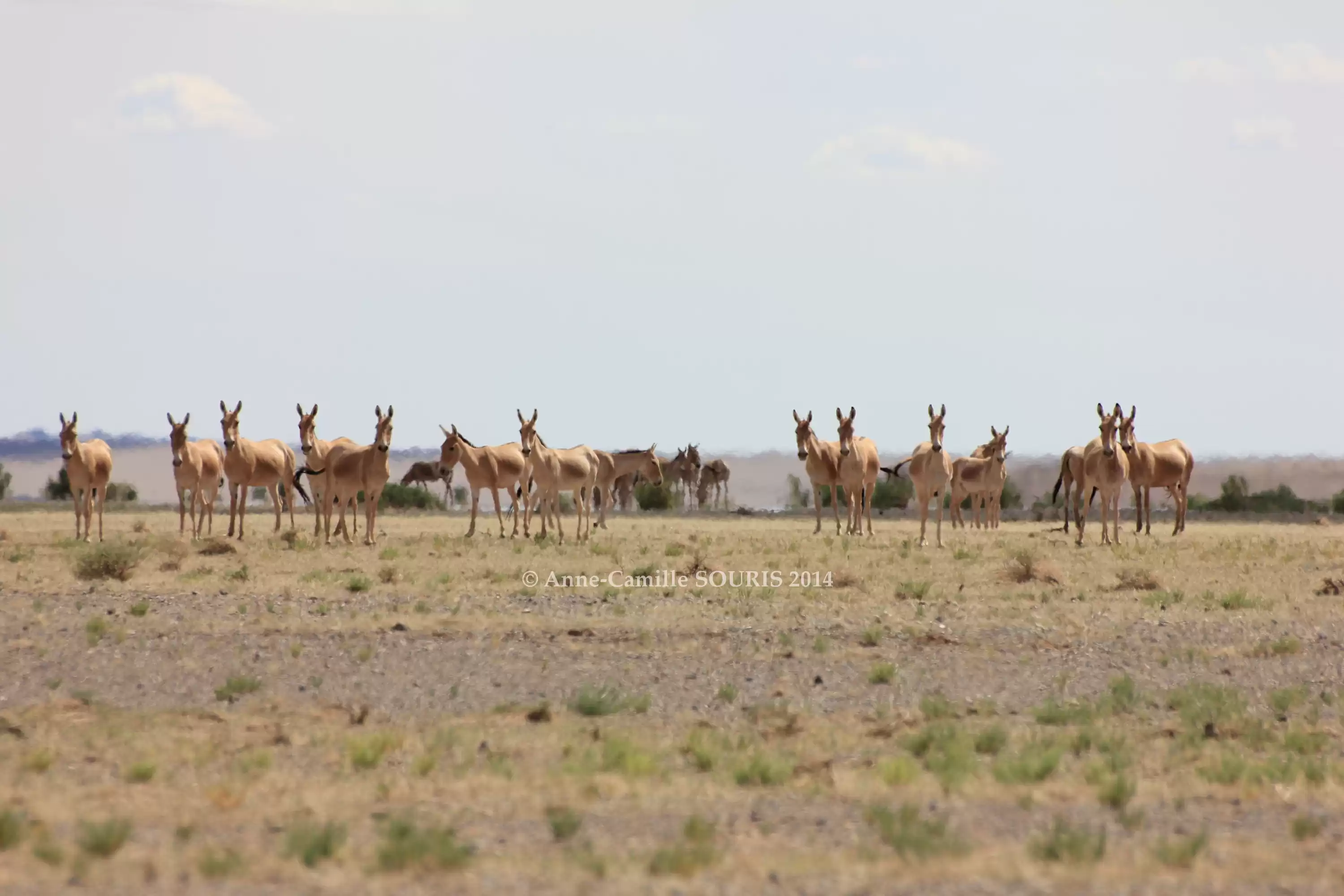
Queen’s Spring Located just 150km from the Chinese border, this region is a natural habitat for the khulan. It is an area where you can expect to find water holes created by the khulan. Water sources are an important factor in the distribution of Khulan populations including natural springs such as the one at Queen’s Spring. In the summer months the species occurs within 10-15 km of standing water, and this range increases in the winter when it is not restricted by water availability as there is typically snow fall. In fact, NGO's scientific team has observed Khulan digging holes in a dry river bed to access water.
Day 8: Sainshand, Mongolia
Khanbogd Just 10 years ago, the district of Khanbogd, in southern Mongolia’s Omnogovi province, was barely visited – just home to a community of local herders. That changed with the discovery of gold and copper deposits and the creation of the Oyu Tolgoi mine – Mongolia’s largest copper mine. Khulan waterpoints are clustered along the edges of the Khanbogd massif in the mining infrastructure corridor. Hence Khanbogd is an important research area especially as OT offsets have included the protection of 80,000㎢ of khulan habitat.
Day 9: Sainshand, Mongolia
Native Mountain ‘Native Mountain’ is home to a Buddhist monastery. In Mongolia, many mountains, rivers and other natural spaces are revered as sacred – either because they are the residing place of a deity or because they are viewed as a deity in themselves. Often, monasteries were built on such sites as was the one built at Native Mountain. The monastery of the site of the ‘Native Mountain’ was destroyed during the 1930s political purges but since then re-introduction of Buddhism in the 1990s some of Mongolia’s ruined monasteries and temples have become operational again. At ‘Native Mountain’ you will meet with the community of monks and you will have the opportunity to discuss with the monks about their involvement in our NGO conservation program and their actions and motivations towards the protection of the Gobi ecosystem. During your time here you should be able to listen to morning prayers. During part of your visit, you will be specifically focusing on the observation of wildlife to collect additional data for the NGO. This will include visiting a site of petrified wood (it has been protected since 1996 but is threatened because of illegal robbery of the artefacts) as well as meeting community members involved in the khulan project as Citizen Conservationists.
Day 10: Sainshand, Mongolia
Golden Mountain This is a protected natural reserve where dinosaur fossils were discovered in the 1920s by Roy Chapman Andrews and the Central Asiatic Expeditions. Gobi fossils tend to be well-preserved, revealing minute details of life during the Late Cretaceous Period – 80 million years ago. You may also observe black-tailed gazelles, Mongolian (white-tailed) gazelles, Mongolian khulan and birds of prey. Part of the day will be spend meeting a local family who work as ‘citizen conservationists for our NGO's conservation program.
Day 11: Sainshand, Mongolia
During this expedition you will be trained to settle camera traps that will be used by our NGO's conservation program, as well as to collect specific samples depending on our NGO's needs at this time.
Day 12: Ulaanbaatar, Mongolia
Following the route of the Trans-Mongolian train line you will head back to UB. On the drive today you will travel through a diversity of Mongolia’s natural habitats – everything from the wide gravel plains to the gentle rolling steppe. On arrival into UB, we will transfer you to your accommodation and the rest of the day will be yours to create your own experience. We will meet in the evening for a farewell dinner. We will transfer you to the airport or train station on your departure date. Accommodation: Of your own choice Meals: B/L/D Travel: Roughly 550km on asphalt road to (approx 8-9 hours diving time not including stops).
What's included
Dinner in Ulaanbaatar the first day is not included in the price Water as well as tea and coffee for the breakfast are included in the price
Beverages, snacks, souvenirs, alcohol, and activities not listed in this tour are not included in the price.
What to know
Available dates are mentioned above. Other dates can be possible on demand. This tour can be customized, please get in touch with me.
Route & locations
Ulaanbaatar, Mongolia