Takhty Sangin From Dushanbe - 2-day-trip
About this tour
Takhti Sangin
Day-by-day itinerary
Day 1: Dushanbe, Tajikistan to Shahrtuz, Tajikistan
We start our tour (190kms; 5h) to the South Tajikistan Sharituz town, Exploring the town we Visit Khoja Mashad Complex. The Khoja Mashad complex is one of the most interesting architectural monuments in this area. The architectural monument consists of two buildings. At first sight both monuments appear identical. In fact, they are similar in their basic features. At the same time, they differ from each other in the details of the figures and it can be supposed that they were constructed in different time periods”. Further study has shown that the eastern building was dated 9-10th century, and the western one 11-12th century. All the buildings were made of baked bricks. A variety of unique, decorative fir-tree-patterned brickwork themes were used in the western building. The eastern building was constructed as a freestanding central mausoleum with two entrances placed on opposite walls. The brickwork is interrupted by paired vertical brick inserts. The figured brickwork is made from alternating vertically-protruding bricks with three bricks end-to-end. Our next stop is Chiluchor Chashma (“Forty-Four Springs”) is a place which is widely known in Tajikistan, because from the foot of a small hill in the area which was previously a not desert (before irrigation works in the Soviet period), five large springs emerged from underground which, in turn, divide into 39 smaller ones. The water from the springs flows together to form a channel 12–13m wide and full of fish. Overnight Guesthouse
Day 2: Shahrtuz, Tajikistan to Dushanbe, Tajikistan
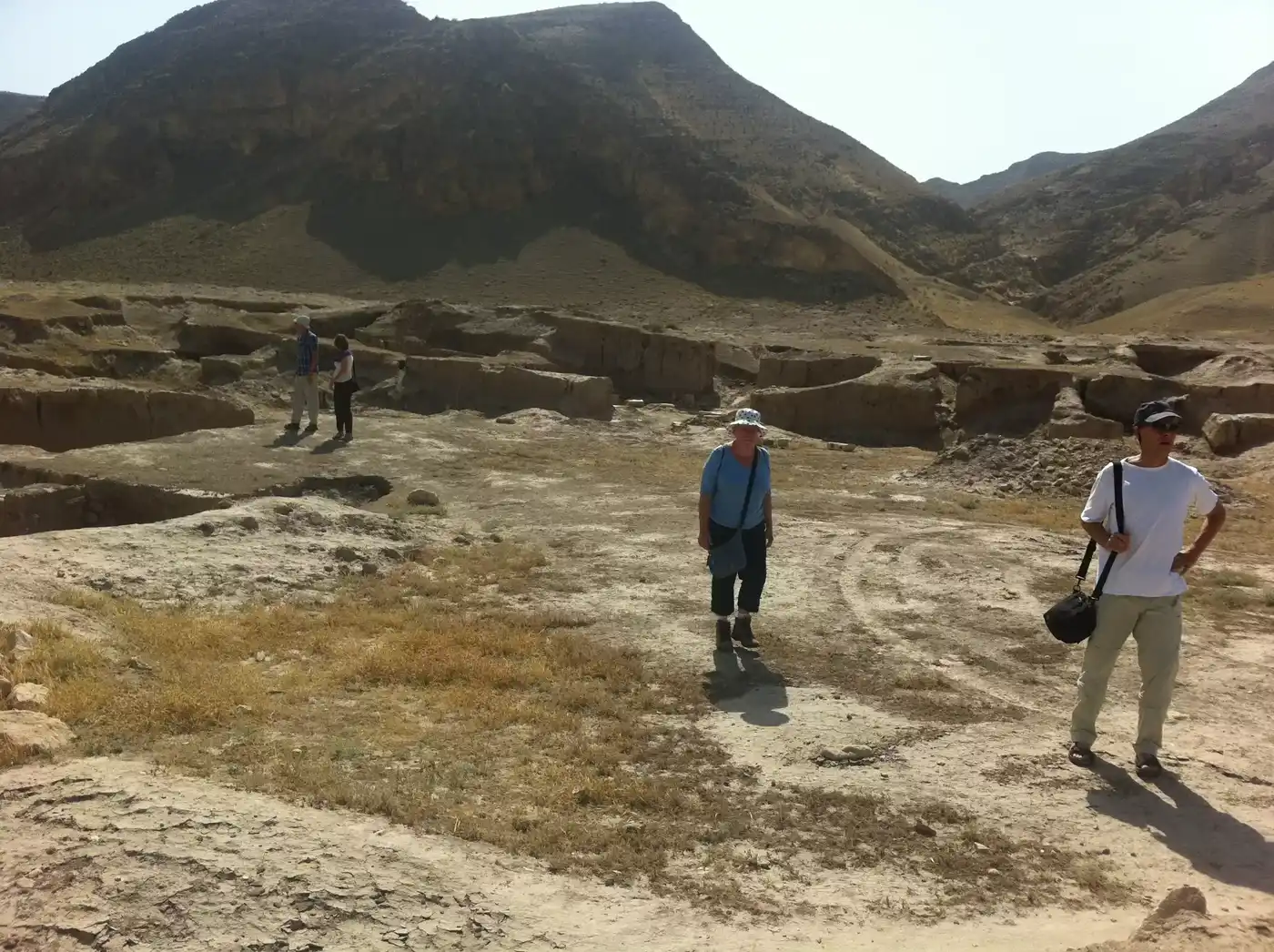
Today is the highlight of our trip. We are visiting Takhti Sangin. The TakhtiSangin site is about 75 hectares and stretches for 2km. Opposite the TakhtiSangin citadel, on the Afghan side of the river, is the TakhtiKubat Fortress. The temple (51 х 51m area) was built in the 4-3rd centuries B.C., and continued functioning until the first century A.D. – the Kushan period. In the temple and its adjacent auxiliary facilities many interesting community gifts to the temple were found. These included the following: a raised bust of Alexander the Great looking like Hercules, a sword sheath engraved with a lion holding a trembling fallow-deer in its clutches, small chest fronts made of ivory and decorated with engravings, the largest collection of arrow-heads in Central Asia , items of weaponry and items from the Greco- Macedonian army. The Archaeological dig in TakhtiSangin continued for 15 years. More than 5,000 finds from the Greco-Bactrian period (polychrome and gilded sculptures, furniture, utensils, jewelers, a gold dedicatory plate with a portrayal of a Bactrian leading a camel, silver and copper coins, etc.) were made. During this time scholars who participated in the research came to the firm opinion that there was a relation between the Amu Darya treasure (Oxus treasure) in the British Museum and the Oxus Temple in TakhtiSangin. After exploring the ruins drive back to Dushanbe.
What's included
Transport Guide accomondation 1 night
hotel In Dushanbe international air tickets
What to know
This tour can be customized. Please get in touch with me.
Route & locations
Dushanbe, Tajikistan to Shahrtuz, Tajikistan