Tour To Gobi Desert And Central Mongolia
About this tour
Tour to Gobi desert and Central Mongolia.
Ulaanbaatar- White Stupa- Yoliin am- Khongor Sand Dunes- Flaming Cliffs- Ongiin Khiid Monastery- Kharkhorin city- Elsen tasarhai- Khustai National park, Ulaanbaatar.
Activities included
Day-by-day itinerary
Day 1: Ulaanbaatar, Mongolia to White stupa, Өлзийт, Mongolia
Day 1. Starting our tour from Ulaanbaatar, we will go to the Gobi desert. Driving about 455 km on an asphalt road, we will stop at a place called White Stupa (Tsagaan Suvarga) The multi-colored cliffs of Tsagaan Suvarga are 60 meters long and 400 meters high. Millions of years ago, this rock was under water. After the sea, dried up due to wind and other natural forces, they eventually changed their shape and color. Different colored layers indicate different time periods if you look at it far from the fact that it looks more like an ancient ruined city. Closer to sunset photo shots. Overnight in the ger camp. L.D.
Day 2: White stupa, Өлзийт, Mongolia to Yolin Am Ice Field, Mongolia
Day 2. Today we visit the Gobi Gurvan Saikhan National Park, the Yolyn Am valley.(210 km). Yolyn-Am is a deep and narrow gorge in the Gurvan-Saykhan-Uul mountains of the Umnugobi aimag, in the south of Mongolia. The valley is named after the lammergeier; this is also why the pad is sometimes called the Valley of the Vultures or the Valley of the Eagles. Yolyn Am is also famous for the abundance of living creatures and "snow in the desert". In these places, due to the proximity to the Gobi Desert, there is very little rainfall. However, in the depths of the Yolyn Am tract, one can find ice and snow cover. The thickness of such an ice field reaches several meters, and even several kilometers by the end of winter. And the ice in summer remains until the end of June due to the shade from the high rocks. The Vulture nests and lives on the top of the cliff and is visible to visitors walking along the valley. The area is also a habitat for ibex and you can see them on the cliff tops. At the entrance to the valley, the Natural History Museum is open to everyone, showing the park's wild games, dinosaur fossils, and various types of vultures. The canyon can be reached by car. We park in a permitted area, go through a beautiful valley into the depths of a steep stone canyon, which almost does not receive the sun's rays, so it is always very cool in it. The hike lasts 2.5 to 3 hours on both sides. Overnight at the ger camp. B.L.D
Day 3: Yolin Am Ice Field, Mongolia to Khongoriin Els, Mongolia
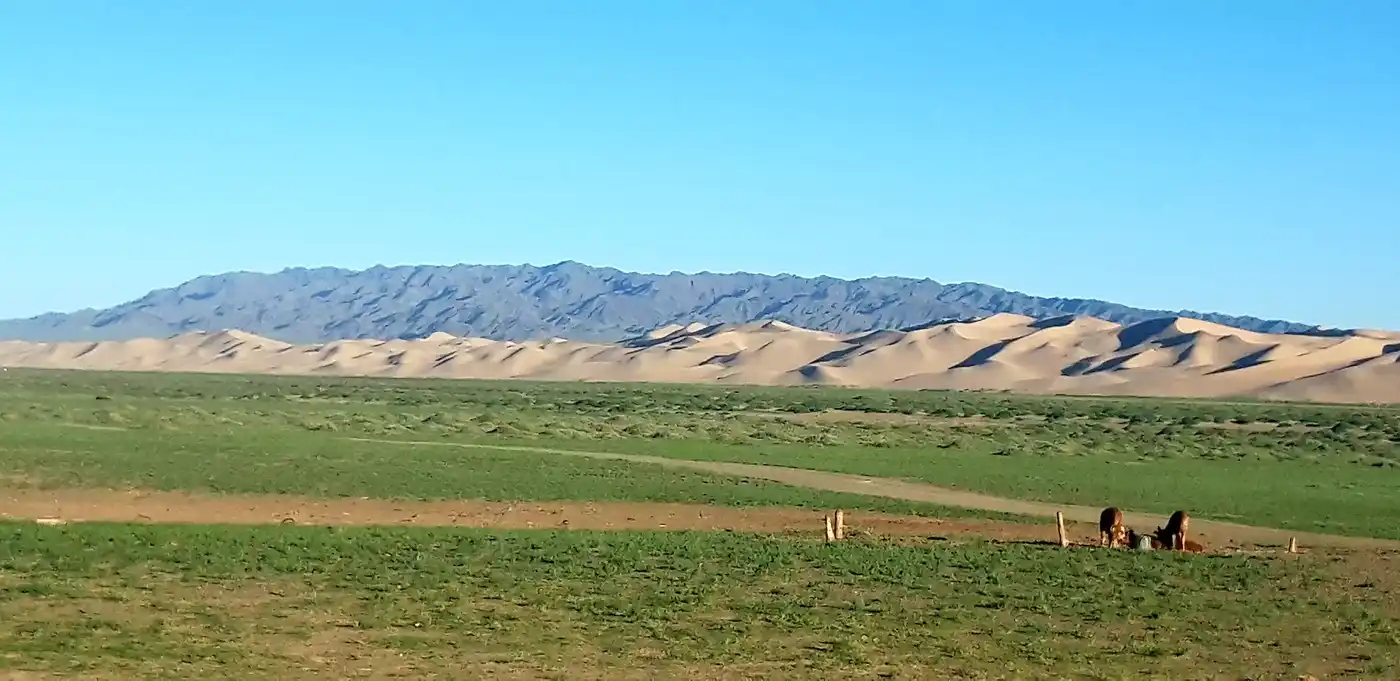
Day 3. Today we are go to the Khongor Sand Dunes. (130km) Khongoryn Els also called Duut Mankhan, commonly known as "The Singing Sands". It is located in the Gobi Gurvan Saikhan National Park in Mongolia. The sand dunes extend over an area of over 965 square kilometers. Khongor is the second largest sand dune in the country, which stretches along the northern part of the Sevrey and Zolun mountain ranges. Its width ranges from 5 to 10 km, its length is about 100 km, the ridges rise 80-300 m above the surrounding landscape. The booming sound made by masses of moving sand can be heard from afar, especially in the early morning hours before sunrise. Tourists, hearing the sound, think that it is the sound of a flying plane. Hence the locals called it Singing Sands. There is an oasis near the Khongor River on the northern edge of the dunes. When we travel to the Gobi Desert we meet a lot of camels, as this place is a habitat for camels. Therefore, we will have the chance to visit the family and get to know their daily life. We drive a short distance to the dunes and can climb to the top of the highest dune (about 300m) (it takes from 40 minutes to 1 hour). And closer to sunset, you can optionally ride a camel, or take a walk to the dunes and take amazing photos. Overnight at the ger camp. B.L.D.
Day 4: Khongoriin Els, Mongolia to Flaming Cliffs, Mongolia
Day 4. Today we will go to Bayanzag. About 150 km. Bayanzag, lit. "Rich in saxaul", or Ulaan Ereg - red rocks) - an area of the mountain range of the Gobi desert, in the Umnugovi aimag, Mongolia. Important fossil finds have been discovered here. This area is best known for finding dinosaur eggs. In English literature, the name Flaming Cliffs is common, derived from the bright orange rock of the rocks, and assigned by the American paleontologist Roy Andrews, who visited here in the 1920s during the expedition of the American Museum of Natural History. The Mongolian name refers to the saxaul that grows abundantly in these places. Sandy rocks, especially at sunset, are bright red or orange. Bayanzag, a saxaul forest and an area of red rocks "Bayanzag", which were formed from the erosion of sand and rock over many thousands of years. We will explore the area and takes stunning photos just before sunset. Overnight in the ger camp with hot shower. B.L.D
Day 5: Flaming Cliffs, Mongolia to Ongi Monastery, Mongolia
Day 5. Today we are go to the Ongiin Khiid monastery.(180 km). Ongiin Khiid - is a Buddhist monastery in Mongolia, in the Saykhan-Ovoo village of the Dundgov aimag. It is currently in ruins. The only functioning temple of the monastery was restored in 2004. The monastery is located on the slope of Mount Saykhan-Ovoo on the banks of the Ongiin-Gol River. It was built in the period from 1760 to 1810 under the leadership of the hutukhta Ishlhundev and his student Bragri Lama Damtsagdorj. During this period, over a thousand lamas lived in the monastery, there were 28 temples in it. the monastery was completely destroyed in 1939. About 200 monks who remained with him were killed, and the rest were arrested, forcibly removed from monastic dignity and drafted into the army. Get to know this historic monastery, visit the temple and the small historical museum. Overnight in the ger camp. B.L.D
Day 6: Ongi Monastery, Mongolia to Kharkhorin, Mongolia
Day 6. Today we will go to the city Kharhorin.(280 km) Kharkhorin is located at the lower end of the upper valley of the Orkhon River which is included within UNESCO's World Heritage Site Orkhon Valley Cultural Landscape. The location marks the easternmost foothills of the Khangai Mountains, where they meet the rolling steppe of central Mongolia. Nearby are the ruins of the ancient town of Karakorum which, for a short time, served as the capital of the Mongol Empire under Ogedei Khan. Another Kharkhorin landmark is Erdene Zuu monastery and its famous phallic rock. The important Paleolithic archaeological site of Moiltyn-am is located near the bridge over the Orkhon River, just west of the settlement. A modern resort is south of Kharkhorin at Khujirt on the Orkhon River. We will visit Erdene Zuu monastery. Overnight in the Guesthouse.( with hot shower) B.L.D.
Day 7: Kharkhorin, Mongolia to Elsen Tasarkhai, Högönö-Taranaiin-Hüree, Mongolia
Visit Elsen Tasarkhay (Mini sand dunes, these places are on the way t . Visit a nomadic family. Acquaintance with the family, with the traditions and customs of the Mongolian people, and the daily life of nomads. Together with the hostess you will cook the national dish "Buuz" for dinner. Overnight stay in the Mongolian ger. B..L.D.
Day 8: Elsen Tasarkhai, Högönö-Taranaiin-Hüree, Mongolia to Ulaanbaatar, Mongolia
Visit Khustai National Park and see Takh horses. Lunch break, Mongolian national food “ Tsuivan" for lunch
What's included
Price included: • Guide, driver; • 4×4 transport + petrol; • 3 meals per day; • Overnights at the ger camp for 7 nights; • national park permits;
Price excluded: • International and domestic flights; • Visa, extra hotel charges; • Excess baggage costs; • Alcohol drinks; • Personal needs.
What to know
This tour can be customized. Please get in touch with me.
Route & locations
Ulaanbaatar, Mongolia to White stupa, Өлзийт, Mongolia